
Psilocybin is a naturally occurring compound that the body converts into psilocin, the main active substance responsible for much of the immediate psychedelic effect. Although the names are often used almost interchangeably, they describe two different molecules. Understanding their relationship helps explain what happens in the body, why researchers measure one after administering the other, and even why certain mushrooms turn blue when their tissue is damaged.
If you have ever read about magic mushrooms and found yourself wondering why an article suddenly switches from “psilocybin” to “psilocin”, the confusion is understandable. The names look similar, both compounds can occur in mushrooms, and discussions do not always explain where one ends and the other begins. Fortunately, the distinction is much easier to grasp than the terminology suggests. It starts with a small chemical attachment that the body can remove, changing how the molecule behaves.
Two similar molecules with one important difference
Psilocybin and psilocin share much of their chemical structure, but psilocybin carries an additional phosphate group, a small cluster of atoms containing phosphorus and oxygen. When that group is removed, psilocybin becomes psilocin. It may seem surprising that such a small change can matter, but molecules depend on their structure to interact with their surroundings. Much as a slight change to a key can affect how it fits a lock, changing one part of a molecule can alter its behaviour.
Are both compounds found in mushrooms?
Both psilocybin and psilocin can occur naturally in mushrooms, so psilocin is not something that exists only after the human body produces it. Their concentrations can vary between specimens, and a mushroom does not contain a fixed, universal mixture of the two. Inside the body, however, their relationship takes on a particular significance: psilocybin becomes a source of psilocin, which is why the two names appear together so often in explanations of psychedelic effects. If you would like a broader introduction first, our article explaining what psilocybin is provides the background.
What happens when the body encounters psilocybin?
The body converts psilocybin into psilocin by removing its phosphate group, with much of this happening in the digestive system before the substance reaches the general bloodstream. Enzymes, proteins that help chemical reactions happen, take part in this process. You already rely on enzymes whenever you digest a meal; here, they help make a specific change to a molecule. Scientists call the removal of the phosphate group dephosphorylation, but behind that long word is a relatively simple event: one chemical attachment is removed, leaving a different compound.
This is why psilocybin is described as a prodrug, meaning a substance that the body converts into a more active form. Psilocin is its active metabolite, or an active substance produced during that processing. The distinction is useful because it separates what enters the body from what subsequently contributes to the effects. Rather than thinking of psilocybin and psilocin as two unrelated ingredients, it helps to see them as connected stages in the same process.
Why do researchers give psilocybin but measure psilocin?
Researchers measure psilocin because they want to follow the active compound after the body has processed psilocybin. Many studies specifically measure unconjugated psilocin in plasma: plasma is the liquid part of blood, while “unconjugated” means the psilocin has not been joined to another molecule during further processing. Although the phrase sounds technical, the underlying question is familiar: how much of the active substance is circulating, and how does that amount change over time? A study can therefore administer psilocybin and discuss psilocin throughout its results without changing the subject. It is simply following what happens next.
How does psilocin affect the way someone sees and feels?
Psilocin changes how certain brain cells respond to chemical messages, which can influence perception, emotions and thinking. To understand this, it helps to know that cells have proteins called receptors that respond to particular substances. Some receptors respond to serotonin, one of the body’s own chemical messengers, and psilocin can interact with several of these too. One receptor, called 5-HT2A, plays a substantial role in psychedelic effects. Psilocin acts as an agonist at this receptor, which simply means it can bind to it and activate it, changing the signals that follow.
What do these changes mean in everyday terms?
Changes in perception can make colours seem more vivid, music feel unusually absorbing or familiar surroundings appear different. Time may seem to move strangely, and thoughts or emotions can become more intense than usual. These experiences are not necessarily pleasant: the same unfamiliarity can feel confusing or frightening, especially when someone struggles to understand what is happening. Knowing about receptors helps explain how such changes can begin, but it does not tell us exactly what an individual will experience or how they will respond emotionally.
Does psilocin simply increase serotonin?
Psilocin’s action should not be understood as simply “adding more serotonin”. Although the two substances can interact with some of the same receptors, they are different molecules and do not produce identical effects. A receptor can respond to more than one substance, just as the same instrument can produce different sounds depending on how it is played. The comparison is only an illustration, but it captures an important point: reaching the same receptor does not mean sending the same message through the brain.
Psilocybin vs psilocin: bringing the differences together
The easiest way to keep the names straight is to connect each one with its role. Psilocybin is the starting compound that the body converts; psilocin is the main active metabolite responsible for much of the immediate psychedelic effect. This does not mean that one molecule alone explains the entire experience, but it gives you a useful foundation for understanding the relationship. When the terminology becomes confusing, the following points are worth returning to:
- They are separate compounds, even though their structures and names are similar.
- Psilocybin becomes psilocin when its phosphate group is removed, a process that happens largely before the substance reaches the general bloodstream.
- Psilocin activates serotonin receptors, including 5-HT2A, contributing to changes in perception and experience.
- Both can occur naturally in mushrooms, so psilocin is not produced exclusively by the human body.
The comparison table below also includes a difference that becomes particularly interesting outside the body: psilocin is more susceptible to oxidation. That brings us to one of the most visible examples of mushroom chemistry, the blue colour that can develop in damaged tissue.
| Feature | Psilocybin | Psilocin |
|---|---|---|
| Chemical relationship | Phosphate-bearing precursor | Dephosphorylated counterpart |
| Role in the body | Prodrug converted to psilocin | Active metabolite |
| Serotonin signalling | Effects mainly follow conversion | Acts at 5-HT2A receptors |
| Oxidation | Relatively more stable | More susceptible to oxidation |
| In clinical research | Often the administered compound | Measured to track active exposure |
What does a mushroom turning blue have to do with psilocin?
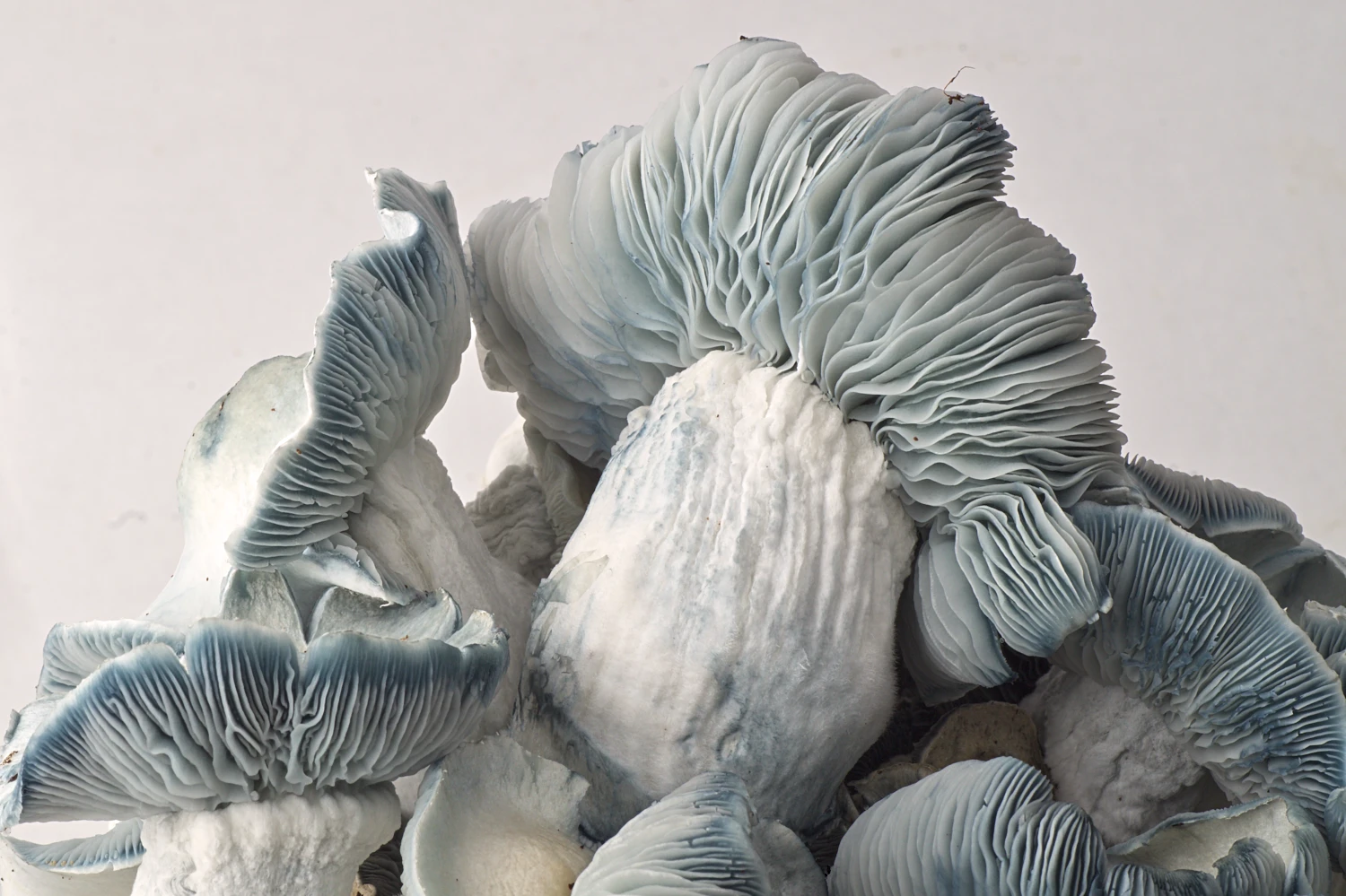
The blue discolouration that sometimes appears when certain mushrooms are bruised is connected to chemical reactions involving psilocin. Research on Psilocybe cubensis revealed a sequence in which one enzyme converts psilocybin into psilocin, while another helps psilocin undergo oxidation, a chemical change involving electrons. Further reactions then produce coloured compounds. What we see as a blue patch is therefore the visible result of substances changing inside the damaged tissue.
A cut apple turning brown offers a familiar comparison. The reactions are different, but in both cases damage allows processes to take place that change the tissue’s colour. This makes blue bruising an interesting illustration of the difference between psilocybin and psilocin: their closely related structures do not mean they behave identically when exposed to the same conditions.
Does a darker blue patch mean more psilocybin?
Although it is tempting to treat a stronger colour as a sign of a higher concentration, blue bruising cannot tell you how much psilocybin or psilocin a mushroom contains. The colour reflects a chemical reaction rather than providing a direct measurement of either compound. It also cannot establish that a mushroom belongs to a particular species or is safe to consume, because other fungi can turn blue through different reactions. The useful lesson is that mushroom tissue contains substances capable of changing after damage; appearance alone cannot tell us the full chemical story.
Why does psilocybin get more attention than psilocin?
Much of the research is named after the compound administered to participants, which is often psilocybin. Psilocin becomes central when researchers explain how that substance is processed and what contributes to its effects. A headline about psilocybin and a discussion of psilocin can therefore describe different parts of the same investigation. One tells you where the process began, while the other helps explain what happened inside the body.
Recognising this connection makes articles about the subject easier to follow. Instead of seeing two competing names, you can understand why both are needed and what each contributes to the explanation. You do not need to remember every enzyme or receptor to grasp the central idea: a small chemical change connects psilocybin with psilocin, and that change matters. For any unfamiliar terminology you encounter along the way, our psilocybin mycelium glossary offers a reference you can return to.
FAQ: six more questions about psilocybin and psilocin
Once the relationship between the two compounds becomes clear, other questions often follow. Where did the names enter scientific research? Can these substances be made without mushrooms? And how much can their chemistry tell us about claims such as microdosing benefits or a supposed “brain reset”? The answers below explore those topics without assuming any background in chemistry or neuroscience.
Who first isolated psilocybin?
Albert Hofmann and colleagues reported isolating psilocybin from Psilocybe mexicana in 1958, helping establish the compound’s identity in the laboratory. This was a milestone in chemical research, but it should not be confused with the beginning of human knowledge of these mushrooms. Indigenous communities had developed traditions involving them long before scientists separated and named their individual chemical components.
Can psilocybin be made without mushrooms?
Scientists can synthesise psilocybin, meaning they produce it through chemical reactions, and its synthesis was reported in 1958. The resulting molecule has the same chemical identity as naturally occurring psilocybin, although this does not make a purified preparation equivalent to a whole mushroom. A mushroom contains many other substances, while the purity and composition of a laboratory preparation can be examined separately.
Are there other related compounds in these mushrooms?
Researchers have identified related compounds including baeocystin, norbaeocystin and aeruginascin, so mushroom chemistry extends beyond psilocybin and psilocin. There is no need to memorise the names to understand the useful point: a mushroom contains a mixture rather than a single isolated ingredient. Detecting a compound in that mixture does not, by itself, establish what effect it has in people or how much it contributes to an overall experience.
How do scientists distinguish psilocybin from psilocin in a sample?
Scientists use laboratory methods that separate a mixture into its components and help identify them. Chromatography separates compounds because they move differently through a testing system, while mass spectrometry helps identify them using measurements related to their molecular mass. These methods allow researchers to examine substances that may be present together, providing information that cannot be obtained from a mushroom’s colour, shape or name.
Does knowing how psilocin works prove that microdosing is beneficial?
Understanding how a substance affects receptors does not establish that taking small amounts improves health, creativity or concentration. In a 2022 double-blind, placebo-controlled study, researchers tested 0.5 g of dried Psilocybe cubensis mushrooms, rather than pure psilocybin, and found no evidence of improved well-being, creativity or cognitive performance under the conditions examined. “Double-blind” means the study was designed to keep participants and researchers unaware of who received the active material or placebo. The distinction between dried mushrooms and pure psilocybin also matters, because mushroom material can contain varying amounts of active compounds.
Does psilocybin really “reset” the brain?
The phrase “brain reset” is memorable, but it suggests something more definite than research has demonstrated. Brain-imaging studies have observed changes in how different regions coordinate their activity, which is closer to a change in how an orchestra plays together than a computer restarting. These findings help researchers investigate psychedelic effects, but they do not show that the brain literally resets or that a mental health condition has necessarily been cured.
Article author
Piotr Kwiatkowski is the founder of MYKOLAB and a self-taught mycology enthusiast who has been developing his knowledge through hands-on practice and personal experiments since 2020. In February 2022, he turned his interest in fungi into a professional business by founding a company that produces mushroom grow kits.
Today, he runs a 550 m² production facility, and his company has produced tens of thousands of mushroom grow kits for individual customers and international business partners. His work focuses on developing proprietary technologies, maintaining production quality and consistency, and making mushroom cultivation simpler.