

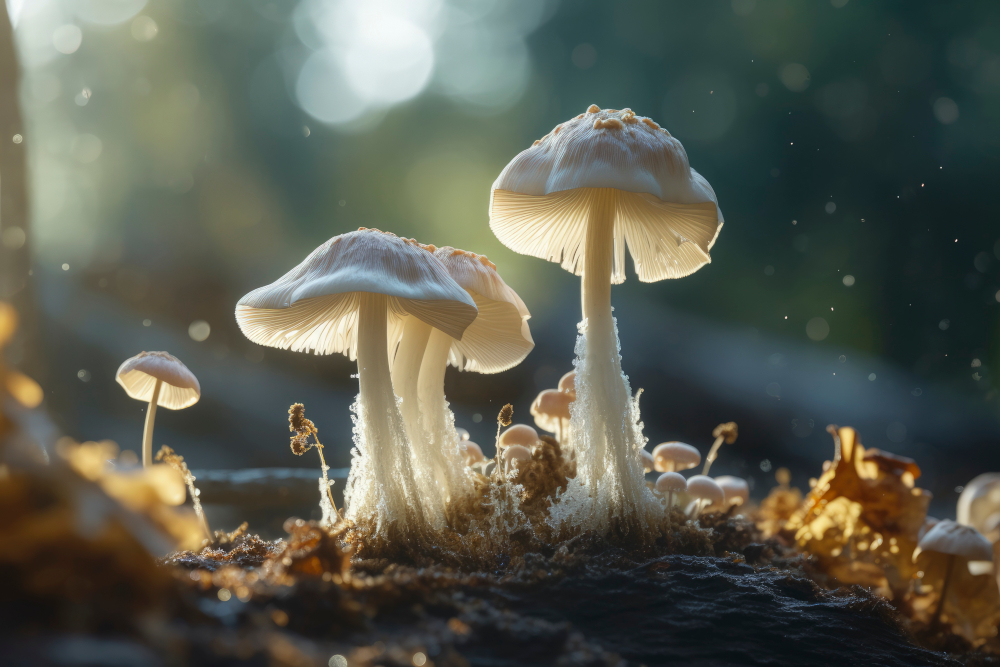

Each mushroom species develops at a slightly different rate. A number of factors influence how quickly the mycelium grows – from the species and strain of the organism to the conditions in which it grows. But how do psilocybin mushrooms colonize? This is a significant issue from the perspective of both licensed labs and those who amateurly study representatives of this amazing kingdom. If this topic interests you, I discuss it in more detail in this article. I encourage you to read it!
Mushrooms – how much time and what conditions do they need to grow?
It’s worth knowing that each mushroom requires slightly different growing conditions. First and foremost, two essential elements are necessary for the activation of spores or mycelium: warmth and moisture. In natural conditions, these organisms often enter into mycorrhiza with plants. This is a type of symbiosis between trees and mushrooms, among others, enabling the better growth of both kingdoms. For this reason, experienced mushroom pickers know that they will find birch boletes under birch trees, boletes under oak trees, and tailor’s mushrooms under aspens.
The important question is – how long does it take for mycelium to develop? In natural conditions, if spores have found fertile ground, and when the mycelium is planted in suitable soil, it takes at least two years before the first fruiting bodies appear. It’s worth noting that the situation is different for mycelium and mushrooms placed on a substrate. However, I’ll talk more about this later in the article.
How long does it take for Psilocybe Cubensis mycelium to develop?
Let’s get to the point. Let’s first consider a typical representative of psilocybin mushrooms – Psilocybe cubensis. Precisely determining how long the mycelium of this species develops is not obvious, due to the numerous variables that determine this process. However, it is indicated that the timeframe for growth in nature ranges from a few weeks to several to a dozen or so months.
Let’s assume, however, that the spores produced by psilocybin mushrooms have found very fertile soil, perhaps even a substrate, with ideal thermal and humidity conditions. How long does colonization take then? According to some reports, in such a case, it lasts from about 2 to 4 weeks.
What happens next? I’ll talk about that later.
Mycelium of other species from the psilocybin mushroom family – how fast does it grow?
It’s worth answering the question – will the mycelium of, for example, Cuban Psilocybe grow faster in nature than that of, for example, the lanceolate Psilocybe? We can assume so, and for several reasons. Why?
First of all – due to the conditions in which it grows (I’ll talk about what influences the development of psilocybin mushroom mycelium at a later stage). On the other hand, observing mycelium in nature is incredibly difficult. In fact, maturity is indicated by fruiting bodies emerging from the ground. Furthermore, the “roots” often grow unevenly, seeking out the best food sources, making them difficult to observe.
Let’s say, however, that we observe mycelium growth under controlled conditions. This means that it is inoculated into a substrate and the package is placed in a location suitable for growth. And what? And from the experience of numerous labs, we can observe that Psilocybe cubensis colonizes rapidly, outgrowing most species in its family. However, it is the nuances that determine what happens, for example, on a slide or in a grow kit. Let’s take a look at them.
What influences the development of psilocybin mushroom mycelium?
Mushrooms, especially in their early stages of development, can be very sensitive to various factors. These can determine the success or failure of the mycelium. However, it’s worth knowing that its development rate depends not only on external conditions, but also on the nature of the specific species or strain.
Mushroom strain and species
That’s where we’ll start this section. Psilocybe cubensis, Psilocybe semilanceata, Psilocybe Natalensis… Each of them has a slightly different development rate. The African species, Natalensis, is quite unfussy when it comes to substrate, colonizing slowly, and losing out to almost all “Cuban” strains in the race.
In part, this is also a result of the fact that Psilocybe cubensis enjoys the greatest interest and is the most widely distributed as a material for observing mycelium activity. Numerous varieties of psilocybin mushrooms are the result of, among other things, selecting “roots” from fruiting bodies with the desired properties. For this reason, you can often encounter strains that are as fast as Sonic, devouring literally everything in their path. Others, on the other hand, can colonize the substrate quite slowly, but successively and vigorously.
So, if you’re looking for suitable research material, also check how quickly they colonize. For example, APE Full Auto is a type of slow-growing mushroom that’s a bit like the tortoise in the parable—it moves slowly but steadily forward until it finally wins the race. In this allegory, it’s impossible not to mention Jack Rabbit Full Auto, its complete opposite, colonizing without restraint.
The form of the material (growkit, spores, and liquid) is also important.
Another issue is the developmental stage of the organism. Spores are by far the most difficult and longest to develop. Psilocybin mushrooms have it “easier” in nature because they drop them onto a substrate they already use and where there is a functioning mycelium. But what if it’s just finding potentially fertile soil, but is developing from scratch? In that case, you should expect that the “seeds” may take weeks, even months, for the first fruiting bodies to appear… unless they become contaminated.
This process is much faster with liquid cultures. They are, in effect, already-prepared mycelium, immersed in nutrients, in which it can survive, waiting until it reaches fertile soil. However, even then, effective colonization can take weeks. However, when placed in a transparent container, it already provides an incredible spectacle!
Colonization is definitely fastest in growkits. After all, these are not psilocybin mushroom spores or even mycelium hyphae, but developed “roots” on the substrate, which can still grow. The rate depends on the strain… but also on the climatic conditions.
Climatic conditions
This is an extremely important factor. Proper temperature, humidity, air circulation… These elements often determine whether the mycelium will have optimal development conditions. For example, if it’s too cold, it can go into hibernation mode. However, if the temperature rises too high, it can sometimes dry out or even spoil. The optimal temperature range is generally around 21°-25° Celsius.
The same applies to humidity. Too low again risks overdrying, while too high can cause the mycelium to rot. Adequate ventilation is therefore crucial, allowing for the removal of produced gases, excess moisture, and heat to the outside, while also protecting against contamination.
However, if you’re passionate about observing the growth of Psilocybe cubensis mycelium, know that our grow kits have the ideal humidity. However, remember that they shouldn’t be placed in a room with very dry air. Otherwise, it may dry out, which can threaten the development of the hyphae.
Substrate Type
The substrate on which the mycelium grows is crucial. In nature, fungi themselves decide where they thrive. When cultivating hyphae for microscopic observation under controlled conditions, it’s important to ensure the right, nutritious material. Then they should grow faster.
When do psilocybin mushrooms fruit?
It’s time to move on to purely theoretical considerations. Let’s assume that liquid cultures have already colonized the substrate or the Full Auto grow kit has been activated. When could fruiting bodies grow under the right conditions? This, again, depends on the strain. Some, for example, may colonize rapidly, but fruit much more slowly.
However, these data can be averaged. The first buds (primordia/pins) to appear are the first, growing about 1-2 weeks after full colonization. Only then do fruiting bodies develop. These, in turn, can grow for up to 4 to 8 weeks before reaching maturity.
Where do users obtain psilocybin mushrooms?
Theoretically, Psilocybin lanceolata (also containing psilocybin) can be found in Poland. However, distinguishing it from other species, often poisonous, can be challenging for someone unfamiliar with mushroom picking and mycology. Therefore, if research is to be conducted, it should be done only with proven material. People interested in psilocybin mushrooms usually reach for special packages containing mycelium or spore products for inoculation onto a substrate.
What is such a “package”? It’s nothing more than active mycelium, ready to fruit. It’s worth mentioning that their cultivation in Poland is prohibited. However, such products contain only mycelium, which does not contain any banned substances. This allows for legal trade and the acquisition of material for microscopic observation.
Strictly speaking, the grow kits found in the shop I run, among others, can be divided into: This is due to both the complexity and the psilocybin content of the fruiting bodies themselves. Theoretically, this is because they shouldn’t be cultivated. Among them, you’ll find, among others, psilocybin mushrooms for beginners. Which ones do some researchers consider suitable for a novice mycologist? Check it out.
A few final words
I mentioned above that these are theoretical considerations. For a simple reason – I remind you that growing psilocybin mushrooms in Poland is illegal. However, it’s worth knowing when they can grow, as under such conditions it’s easier to control the operation of liquid cultures or grow kits and protect yourself from breaking the law.