
We have put together a practical glossary to help you understand the main terms and definitions related to psilocybin mycelium.
5-HT2A Receptors
A subtype of serotonin receptor found in the brain and elsewhere in the body. Psilocin’s activity at these receptors contributes substantially to its psychedelic effects. Their activation influences neuronal signalling and the activity of brain networks. They are a major pharmacological target of classic psychedelics, although these substances can also interact with other receptors.
Agar
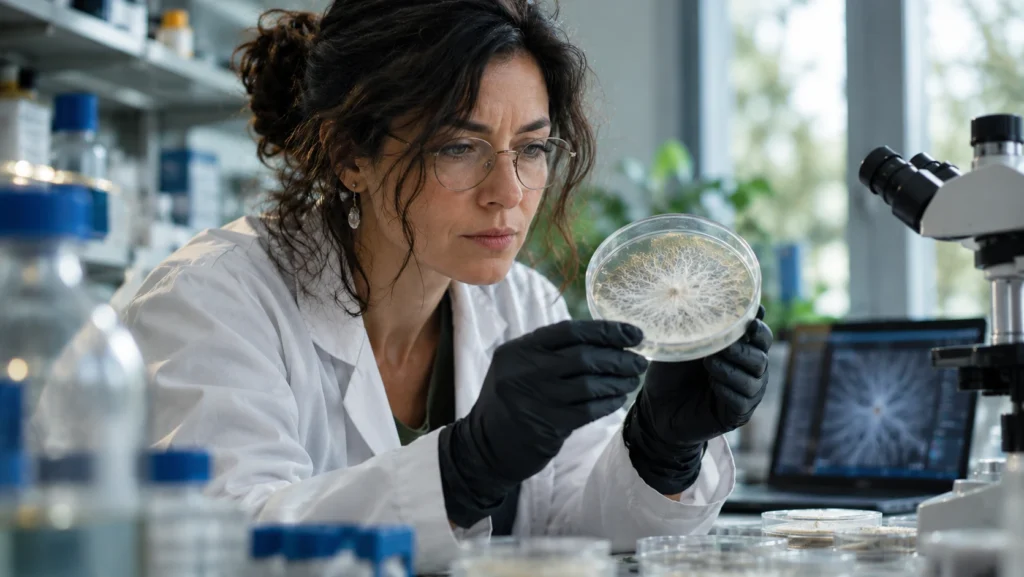
A gelling substance derived from marine algae, used as the basis of mycological culture media in Petri dishes. Agar media allow researchers to separate fungal material from contaminants and isolate mycelial cultures. Their transparency makes it possible to observe the rate and pattern of hyphal growth. Agar is widely used in laboratory work with fungi.
Alkaloids
A group of nitrogen-containing organic compounds produced by various organisms, including fungi. In psilocybin-containing mushrooms, some of these compounds are responsible for psychedelic effects and changes in perception. Examples include psilocybin, psilocin, baeocystin and norbaeocystin, although their individual effects are not equally well understood. Their concentrations vary between species, varieties and environmental conditions.
Autoclave
A laboratory device that uses pressurised steam to sterilise equipment and culture media. A commonly used operating temperature is 121°C, corresponding to approximately 15 psi above atmospheric pressure, with exposure time depending on the load and procedure. The process destroys microorganisms, including bacterial spores. Autoclaves are used to reduce contamination in mycological laboratory work.
Bad Trip
An informal term for a difficult, unpleasant or potentially traumatic experience under the influence of a psychedelic substance. It may involve intense anxiety, paranoia, disorientation and a sense of losing control over the mind or body. A person’s psychological state and surroundings can influence the experience, although distress cannot always be prevented through preparation. Support and subsequent psychological integration may help a person process what happened.
Baeocystin
A naturally occurring compound structurally related to psilocybin and found in a number of psilocybin-containing mushroom species. It belongs to the tryptamine family and usually occurs at lower concentrations than psilocybin. Its pharmacological effects and possible interactions with other mushroom compounds are still being investigated. Claims that it produces an established “entourage effect” in humans remain unconfirmed.
Blue Bruising
Blue discoloration that can develop after fungal tissue is damaged. In some psilocybin-containing mushrooms, it results from enzymatic reactions involving psilocin and the formation of coloured oxidation products. However, other fungi can also turn blue through different chemical mechanisms. Blue bruising alone does not prove the presence of psilocybin, establish potency or identify a mushroom as safe.
Cap or Pileus
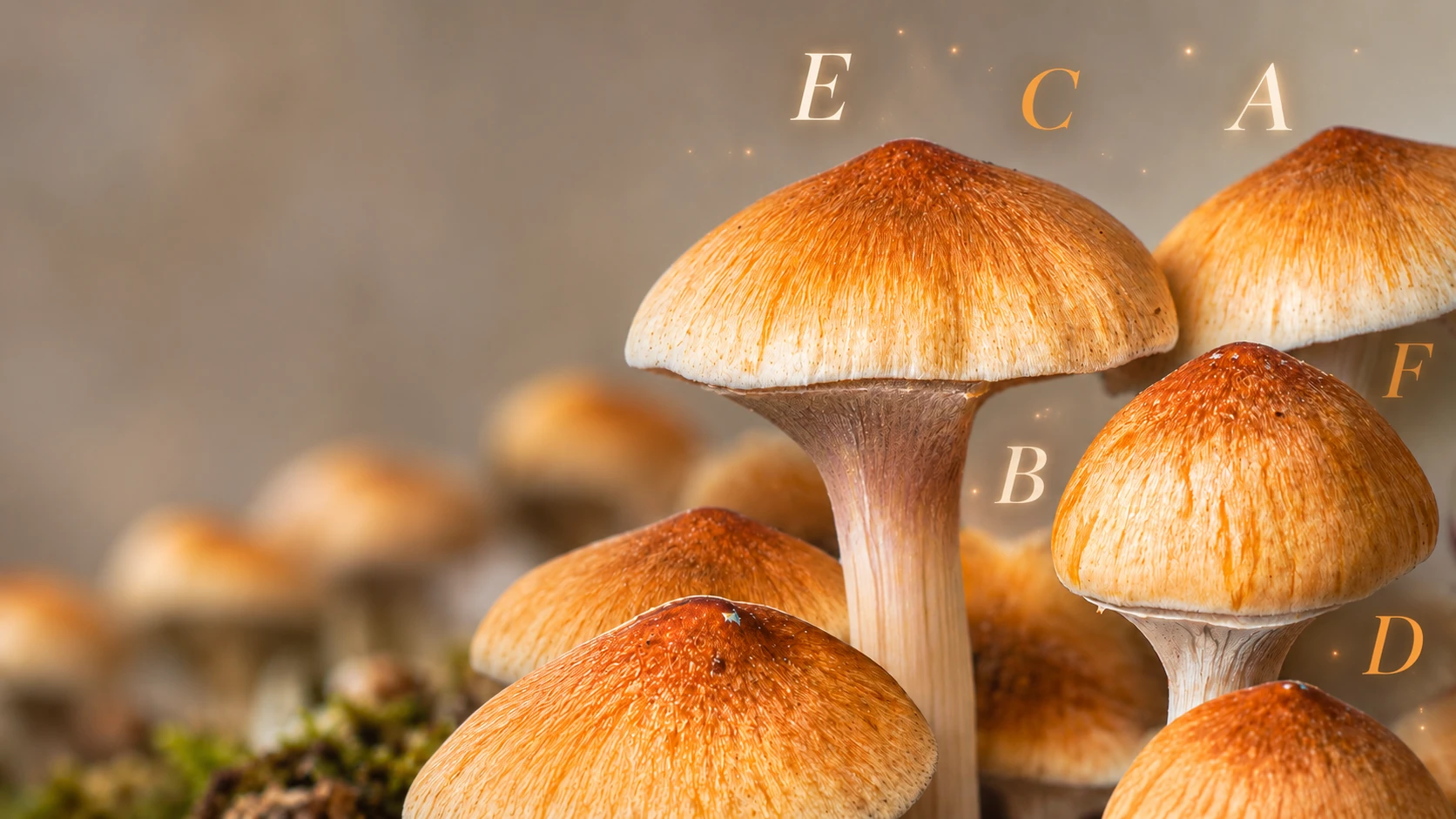
The upper part of the fruiting body in many mushroom-forming fungi. It supports and protects the spore-bearing surface, which may consist of gills. Its shape can change as the fruiting body matures, depending on the species. The concentration of alkaloids may differ between cap and stem, but this relationship is not identical in all specimens.
Colonisation
The process by which growing mycelium spreads through a medium or substrate. Fungal enzymes break down complex organic substances into compounds that can be absorbed. The rate and pattern of growth depend on the organism, the medium and environmental conditions. A fully colonised substrate is not immune to contamination.
Contamination
The presence of unwanted organisms in a fungal culture, including moulds, yeasts or bacteria. Examples include species of Trichoderma and bacteria that cause the deterioration of organic material. Contaminants may compete with the target fungus and interfere with its growth or observation. Contaminated material requires appropriate isolation and disposal procedures.
Deformation and Mutation
An unusual form of a fruiting body that may result from genetic variation or environmental factors. Examples include capless forms, reduced pigmentation and irregular growths sometimes called “blobs”. Some inherited variations become associated with named cultivated varieties. However, an unusual appearance does not necessarily indicate a genetic mutation or a particular level of potency.
Depersonalisation and Derealisation
Experiences involving a sense of detachment from oneself or from the surrounding world. Depersonalisation may feel like observing oneself from outside, whereas derealisation may make the environment seem dreamlike or unreal. These experiences can occur during psychedelic effects, but are not unique to them. They may be temporary, although persistent or distressing symptoms require clinical assessment.
Dephosphorylation
The chemical removal of a phosphate group from a molecule. In the metabolism of psilocybin, this process produces psilocin, the compound chiefly responsible for its psychedelic effects. Enzymes in the body participate in this conversion. Dephosphorylation should not be confused with deprotonation, which means the removal of a proton.
Ego Dissolution
An experience involving a reduction or loss of the usual sense of being a separate self. Some people describe diminished boundaries between themselves and their surroundings or a feeling of unity. Research associates such experiences with changes in brain-network activity, including networks involved in self-referential processing. This does not mean that the default mode network simply switches off, and the experience can be positive, distressing or mixed.
Flashbacks and HPPD
A flashback is a recurrence of aspects of a previous drug experience after the substance’s immediate effects have ended. Hallucinogen persisting perception disorder, or HPPD, involves recurrent or persistent perceptual disturbances associated with significant distress or impairment. Symptoms may include visual trails, afterimages or other visual distortions. A brief flashback and clinically diagnosed HPPD are not interchangeable terms.
Flush
A wave of fruiting bodies produced by the same mycelium during one period of fruiting. A substrate may support several successive flushes while sufficient resources remain available. Their number and size vary with the organism and conditions. Earlier flushes are often more abundant, but a fixed number cannot be guaranteed.
Fruiting Body or Basidiocarp
The reproductive structure of a fungus, commonly referred to as a mushroom. In basidiomycete fungi, it carries the structures that produce and release spores. Many familiar forms consist of a stem topped by a cap, although other shapes occur. In psilocybin-containing mushrooms, the fruiting bodies contain psychoactive compounds in concentrations that vary between specimens.
Fruiting Chamber
An enclosure used in mycology to maintain environmental conditions for fruiting-body development. Designs described as monotubs or shotgun fruiting chambers, abbreviated SGFC, are examples of such enclosures. They influence moisture retention and gas exchange. Their design and use vary with the species and the research or cultivation context.
Full Auto Grow Kit
A commercial term used for grow kits marketed as requiring little intervention. Some designs incorporate filter membranes intended to regulate gas exchange and help retain moisture. The exact construction and claims vary between manufacturers. “Full auto” is not a standard scientific classification or a guarantee of fully autonomous development.
Gills
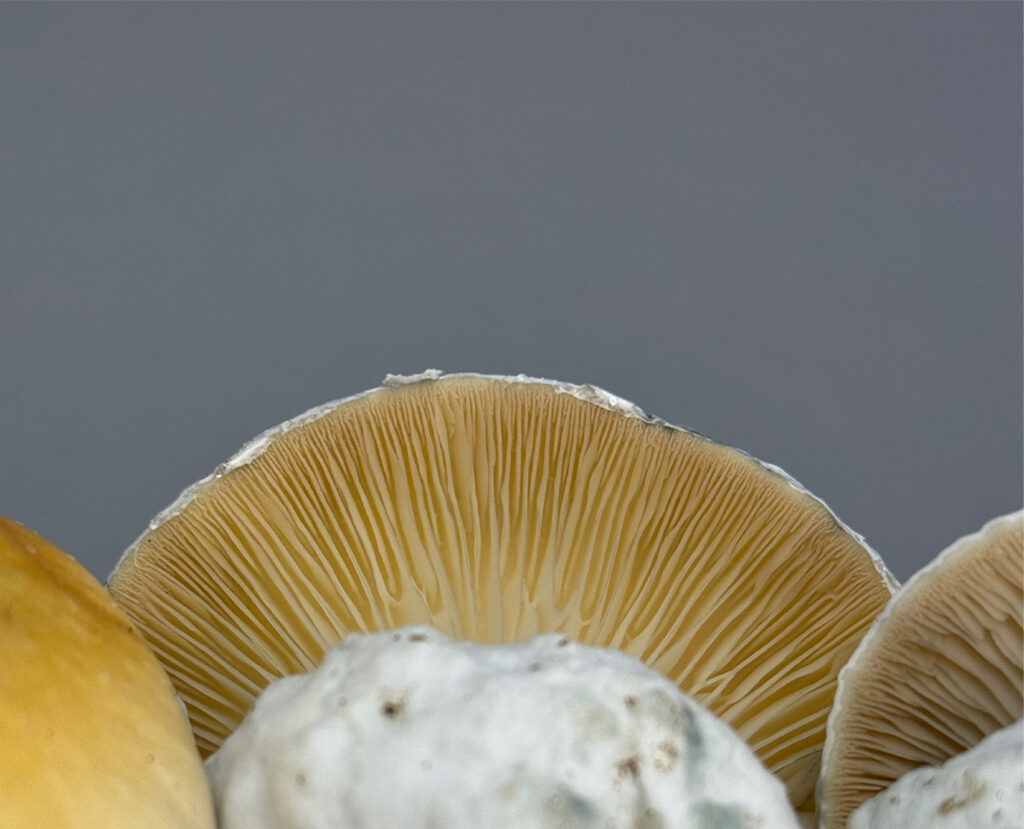
Thin, plate-like structures on the underside of the cap of many mushrooms. Their surfaces carry basidia, the microscopic structures that produce spores. In many psilocybin-containing species, the gills become darker as spores mature, often taking on brown or purplish tones. Gill colour and structure help with identification, but do not establish a species on their own. Read more: Psilocybe and Panaeolus: microscopic similarities and differences.
Grow Kit
A prepared kit containing fungal material and a substrate, usually supplied in a container. The substrate provides moisture and resources for the mycelium. Such kits are marketed for different purposes, including mycological observation and, where permitted, cultivation. The intended use and legal status depend on the species, the product and the jurisdiction. Read more: How to choose mycological material for observation.
Incubation
A period during which inoculated material is kept under controlled conditions to support growth or observation. During this stage, hyphae spread through the available medium. Appropriate conditions depend on the species and the purpose of the work; total darkness is not a universal requirement. In substrate-based cultures, this stage is often associated with the progressive colonisation of the material.
Inoculating Loop
A laboratory instrument with a small loop at its tip, commonly made from metal wire. It is used to transfer small samples of microorganisms or biological material onto culture media. Reusable metal loops are sterilised between uses, while disposable versions are also available. In mycology, the tool supports the handling and isolation of fungal cultures.
Inoculation
The introduction of biological material into a prepared medium. In mycology, the inoculum may consist of spores, liquid culture or another form of living fungal material. Aseptic handling limits the introduction of unwanted organisms. Inoculation begins a new stage of fungal growth in the receiving medium.
Lemon Tek
An informal name for preparing psilocybin-containing mushrooms with lemon juice. Users describe differences in the onset, intensity and duration of effects, but these claims have not been established by robust controlled research. The common explanation that lemon juice reliably converts psilocybin into psilocin before ingestion is also not established. It should not be presented as a proven method of preventing nausea or controlling the experience.
Liquid Culture
A culture containing living mycelium in a liquid nutrient medium. The fungal tissue forms a suspension rather than growing only on the surface of a solid medium. This distinguishes it from a spore suspension, which contains reproductive cells rather than an established mycelial culture. The term overlaps with “mycelium in liquid”.
Microdosing
The practice of taking small amounts of a psychedelic substance with the intention of avoiding a full psychedelic experience. People report using it for mood, creativity or concentration, but reported benefits do not establish clinical effectiveness. Controlled research is still examining these claims and the contribution of expectations and placebo effects. There is no universally validated therapeutic schedule for psilocybin microdosing.
Mycelium
The vegetative body of a fungus, consisting of a network of microscopic filaments called hyphae. It grows within or across a suitable medium, releasing digestive enzymes and absorbing and transporting nutrients. In mushroom-forming species, fruiting bodies can develop from the mycelium under appropriate conditions. The visible mushroom is therefore only one part of the organism. Read more: How to choose mycological material for observation.
Mycelium in Liquid
Living fungal hyphae suspended in a liquid nutrient medium. In laboratory mycology, this material is also known as a liquid culture. Because it contains living mycelium rather than only spores, it can be used to study and propagate an existing culture. Its purity and suitability depend on laboratory handling and the absence of contamination.
Mycorrhiza
A symbiotic association between a fungus and a plant’s roots. In many such relationships, the fungus helps the plant obtain water and mineral nutrients and receives carbon compounds produced through photosynthesis. These associations play a substantial role in terrestrial ecosystems. They should not be confused with the saprotrophic nutrition of familiar Psilocybe species, which obtain nutrients from dead organic material.
Partial Veil and Ring
A partial veil is a layer of tissue that covers the developing gills in some young mushrooms. As the cap expands, the veil may break and leave a ring, also called an annulus, around the stem. Deposited spores may darken this remnant. The veil and the ring are related structures, but are not the same anatomical feature.
Pinning
The stage of fungal development at which the mycelium begins forming the initial structures of fruiting bodies. Small aggregations of hyphae develop into primordia, some of which become visible as “pins”. This marks a transition from vegetative growth towards reproductive development. Environmental conditions influence whether these structures continue to develop.
Pins and Primordia
Early structures from which fruiting bodies develop. Primordia arise from organised aggregations of hyphae, while “pins” is an informal term for small, visible developing mushrooms. Their further development depends on the organism and its environment. Some stop developing and are informally referred to as “aborts”.
Psilocin
The active compound formed when psilocybin undergoes dephosphorylation in the body. It can cross the blood–brain barrier and interact with serotonin receptors. It is susceptible to oxidation, with stability affected by environmental conditions. Oxidative reactions involving psilocin contribute to the characteristic blue discoloration seen in damaged tissue of some psilocybin-containing mushrooms.
Psilocybe cubensis
A psilocybin-producing mushroom species associated with dung and commonly found in tropical and subtropical environments. It is one of the best-known species in mycological research and commercial discussions of psilocybin mushrooms. Numerous named cultivated varieties differ in appearance and other characteristics. Alkaloid content varies and cannot be reliably inferred from a variety name alone.
Psilocybe semilanceata
A psilocybin-producing mushroom commonly known as the liberty cap. It occurs in grasslands and pastures in temperate regions, including Europe, and has a small, typically pointed cap and a slender stem. It is a saprotrophic species rather than a mycorrhizal fungus. Its chemical composition varies, and appearance alone does not provide a reliable measure of alkaloid concentration.
Psilocybin
A naturally occurring psychedelic compound in the tryptamine family, produced by several groups of fungi, including species of Psilocybe. It acts as a prodrug, meaning that the body converts it into the active compound psilocin. Its effects can involve changes in perception, emotion and thought. Researchers are investigating psilocybin-assisted interventions for conditions including depression and some substance use disorders.
Pure Culture
A fungal culture free from other organisms, such as bacteria, yeasts or moulds. Laboratory isolation may involve transferring selected fungal material to fresh agar media. This allows researchers to study a culture’s characteristics without interference from contaminants. A pure culture is not necessarily a single genetically uniform strain.
Rhizomorphs and Rhizomorphic Growth
Rhizomorphs are organised, cord-like aggregates of fungal hyphae. The term “rhizomorphic growth” is also used to describe a root-like or rope-like appearance in mycelial cultures. Growth form is influenced by the organism and environmental conditions. This appearance alone does not demonstrate superior genetics, freedom from contamination or future fruiting performance.
Saprotroph
An organism that obtains nutrients by breaking down dead organic material. Saprotrophic fungi release enzymes into their surroundings and absorb the resulting smaller molecules. Many familiar psilocybin-producing fungi belong to this nutritional group. The older term “saprophyte” is still encountered, although “saprotroph” is more precise for fungi.
Set and Setting
A concept describing factors that influence a psychedelic experience. “Set” refers to a person’s internal state, including expectations, emotions, mindset and mental health. “Setting” refers to the physical and social environment, including the presence of other people. Both can influence the experience and the likelihood of distress, but neither guarantees a predictable outcome.
Spore Print
A deposit of spores released from the spore-bearing surface of a mature mushroom onto a surface such as paper or foil. Its colour and appearance can assist with identification. Spore prints are also used to collect material for microscopic examination and research. They contain spores with genetic variation and should not be treated as exact genetic copies of the parent mushroom. Read more: Psilocybe and Panaeolus: microscopic similarities and differences.
Sterilisation
A validated process intended to eliminate viable microorganisms, including resistant spores. In laboratory mycology, moist heat under pressure is commonly used to sterilise suitable equipment and media. Sterilisation is different from disinfection, which does not necessarily eliminate all microbial forms. Its effectiveness depends on the method, exposure conditions and material being treated.
Substrate
The material on or in which mycelium grows. Depending on its composition, it can supply nutrients, retain water or provide physical support. Materials used in mycology differ in their nutritional and structural roles; not every substrate component is itself a food source. Preparation requirements depend on the material, organism and laboratory procedure.
Tryptamines
A family of organic compounds with a structure based on an indole ring and an aminoethyl side chain. It includes biologically important compounds and derivatives such as serotonin and melatonin, as well as psychedelics such as psilocin and DMT. Psilocybin is a phosphorylated tryptamine derivative. Structural similarities help explain some receptor interactions, but different tryptamines do not have identical effects.