

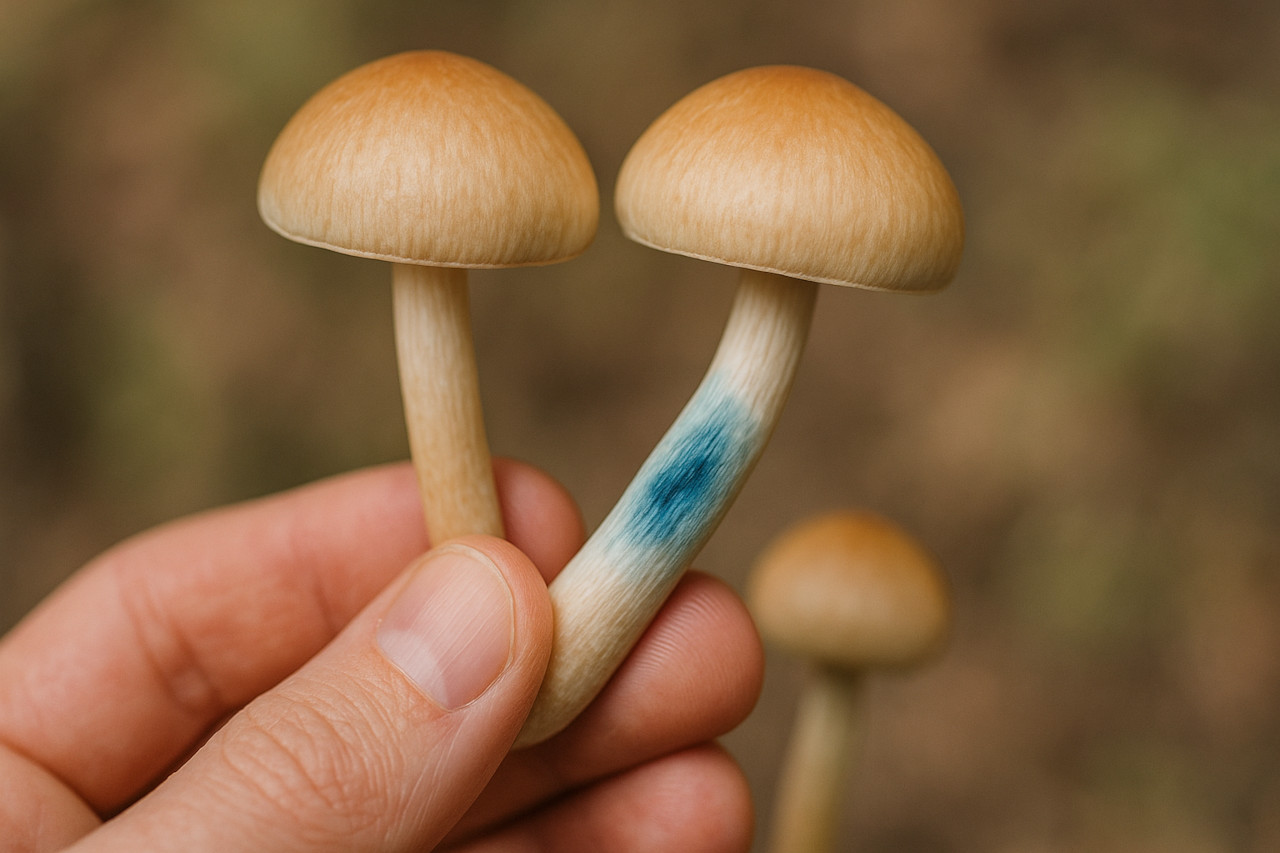

Often, while reading articles or descriptions about selected strains of Psilocybe cubensis , as well as other mushrooms of this genus, you may have learned that after damage, for example, to the stem, their tissue turns blue. This description is usually accompanied by information that this is due to the presence of psilocybin. In this article, however, I would like to present this mechanism in more detail so that you have a broader understanding of why psychoactive mushrooms turn blue. Are the alkaloids present in the mushroom themselves causing the bluish-blue color? Or is something else going on here? To find out – read this text!
Why do psilocybin-containing mushrooms turn blue?
Psilocybin mushrooms are usually light in color (with the exception of the caps, which can be light or darker, depending on the humidity). The stems are usually cream, sometimes with shades of yellow. In young fruiting bodies, the gills are also lighter – usually light gray, gray-brown, or beige. However, disturb the tissue, and a characteristic bluish color appears.
Albino varieties of Psilocybe cubensis are a separate topic. In these varieties, even without damaging the stems, caps, or any part of them, blue or livid blooms appear. What is the mechanism behind this?
In both cases, the presence of psilocybin and psilocin is significant. Let’s focus first on the fully pigmented varieties. When the tissue is damaged, the alkaloids come into contact with oxygen. This, in turn, causes them to begin to oxidize, which in turn produces a blue color.
For many years, this mechanism was somewhat mysterious, even to scientists. However, years of research led Dirk Hoffmeister’s team at the Leibniz Institute for Natural Product Research and Infection Biology to conclude that the appearance of the blue color, compared to indigo, is caused by several compounds resulting from the oxidation of psilocybin mushroom alkaloids. Among them are quinoid psilocybin oligomers. These are products of a cascade reaction that psilocybin undergoes when the mushroom tissue is damaged. Under the action of a phosphatase (enzyme), a phosphate group is removed from this substance, converting psilocybin to psilocin. Another enzyme, lactase, acts as an oxidant, creating psilocybin radicals. These, in turn, bind into C-5-linked subunits and then polymerize to C-7. This group of compounds is responsible for the formation of blue pigments, which we see as a bluish tinge.
Why do these mushrooms turn blue?
Intriguingly, even though we’ve learned about this mechanism thanks to German researchers, we still don’t know what it’s for. Several theories have been put forward. One of them is linked to the theory of psilocybin as a defensive substance produced by mushrooms – the blue color is supposed to be a protective element against parasites and predators; a kind of warning signal that “if you eat me, you’ll feel, at the very least, strange.” Another theory suggests it could serve as camouflage – in the shade of tropical vegetation, the blue-tinged mushrooms would potentially be less visible. Another suggests it’s a form of disinfection. When damaged, the fruiting bodies often rot, and the oxidizing psilocybin and the resulting compounds are thought to protect the damaged areas from microbial attack. Ultimately, some scientists consider this to be a simple coincidence.
What about albino varieties?
Perhaps this question has occurred to you when reading about the bluish discoloration of damaged Psilocybe cells. And rightly so, although there’s a fairly simple explanation for this. Pigments in living creatures, including humans, have a certain protective function, for example, against UV radiation (which is why the closer to the equator, the darker a person’s skin color is, due to greater sun exposure). These compounds also contain antioxidants, which protect against free radicals.
Albino varieties, by definition, lack pigments. This means that these individuals are more exposed to external factors. Their tissues are often much thinner and more permeable. Furthermore, the lack of pigments means fewer antioxidants. This, in turn, increases susceptibility to spontaneous oxidation and micro-injuries. The result is a bluish discoloration in strains such as the APE or TAT.
Do all Psilocybe mushrooms turn blue?
It’s worth knowing that not all psilocybin-containing species turn blue equally. There are psilocybin mushrooms that turn blue very little or not at all. Examples include:
- Psilocybe mexicana,
- Psilocybe tampanensis,
- species outside the genus Psilocybe, including fromGymnopilusorInocybe.
The reasons for this include lower alkaloid content and reduced activity of oxidative enzymes. In other species, this may be the result of other compounds that block bruising.
Psilocybin mushrooms aren’t the only ones that turn bruised!
Finally, it’s worth adding one more thing – although bruising in mushrooms is associated with the process of psilocybin oxidation, it’s important to remember that not only “magic mushrooms” have this property. This is also a typical phenomenon for many edible species, including the red-leafed bolete and some bay boletes. Interestingly, this effect results from exactly the same mechanism, i.e., the oxidation of compounds contained in the pulp, but of a completely different nature than psilocybin.