

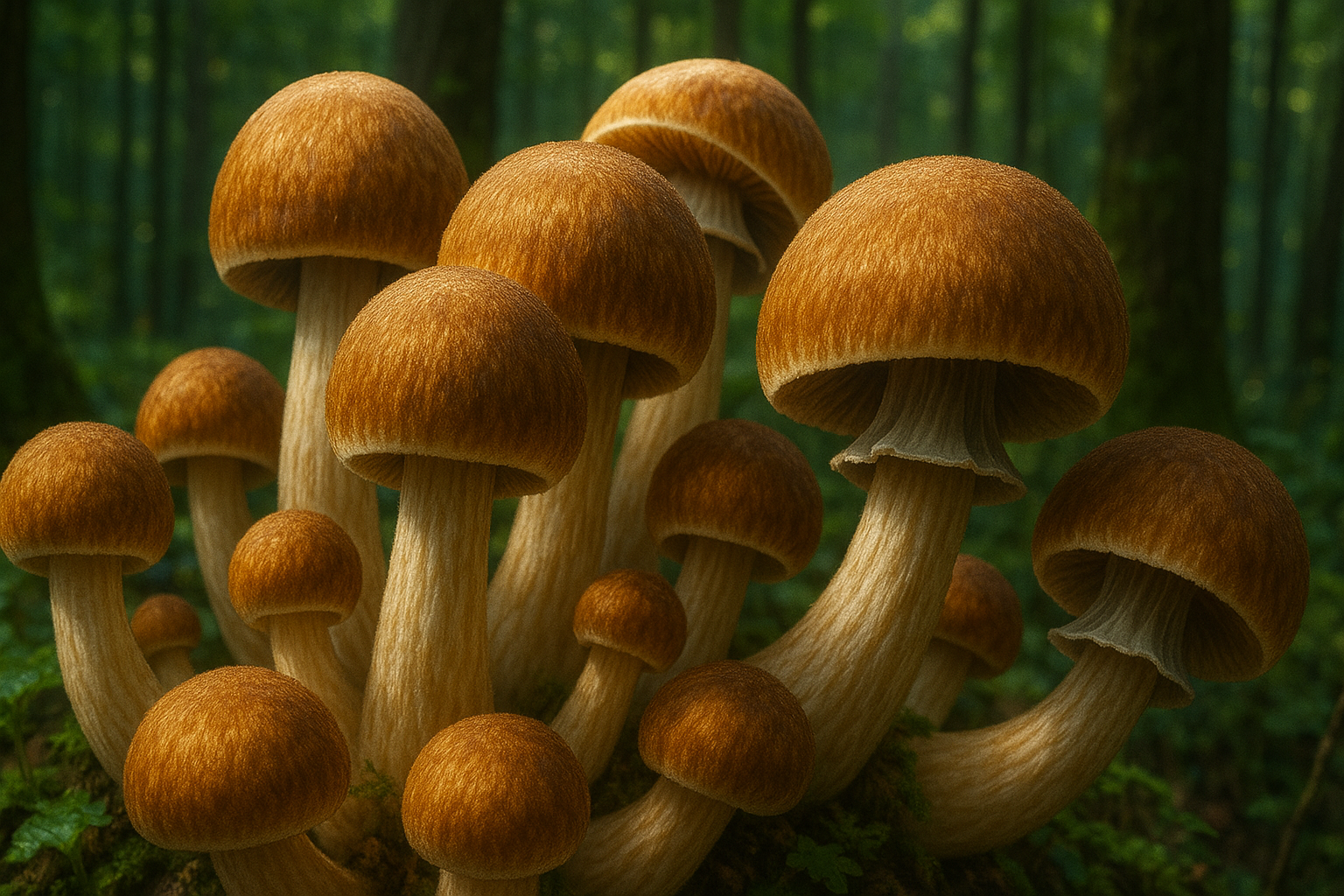

When we talk about psilocybin mushrooms, we usually mean Psilocybe subcubensis. It’s a widely known mushroom, and mycologists from around the world are working on its various varieties. Sometimes other local species are mentioned in this context, including Psilocybe lanceolata, found in Europe, and certain African varieties. However, in discussions among fans of observing mushroom life under a microscope, another hero is increasingly emerging – Psilocybe subcubensis. What is this species? What makes it unique? Where can it be found? What distinguishes it from the most widely known “magic mushroom”? You’ll learn more in the article below. I encourage you to read it!
Psilocybe subcubensis – what species is this?
At first glance, the Psilocybe subcubensis (as its Polish name is) doesn’t differ much from Psilocybe cubensis. It’s not without reason that it’s called a “sister species” to the Cuban Psilocybe. However, there are some differences between them, which we’ll discuss below.
First and foremost, when describing it, it’s important to note that it’s another entheogenic species, meaning it induces altered states of consciousness. This is due to the presence of psilocybin and, to some extent, psilocin in its fruiting bodies. It’s highly likely, therefore, that in ancient times it was used in rituals of contact with spirits or ancestors.
What does the Cuban Pseudo-P … While Psilocybe cubensis begins to tinge with ochre, it gradually shifts to copper or dark gold. A damaged “cap” bluish-grays around the edges.
The gills may be attached or detached (in a more mature form). They are dark gray in color, but with age they may turn purple or even purple with shades of brown.
The stem is rather short – the stem grows 50 to 80 mm above the “rootlets,” usually thin – typically 4 to 6 mm. It is hollow, therefore soft, and rather straight. Colors range from whitish to cream or yellowish. In mature specimens, the damaged part takes on a bluish tint.
Write it down – almost like Psilocybe cubensis, and yet… There’s one significant, distinct difference – in the spores. It’s true that this is a microscopic feature, but every mycologist – whether professional or amateur – knows how significant it is. The Cuban Psilocybe produces smaller spores, measuring approximately 11 to 13 by 7.7 to 8.8 micrometers. A print made using these mushrooms is a deep brown or bluish-brown.
Where is Psilocybe subcubensis found?
If we were to describe the distribution of the Psilocybe subcubensis mushroom – on a macro scale, this species prefers the tropics, so habitats are usually warm and humid. In the wild, it can be found in Central and South America, including Mexico, Colombia, Honduras, and Venezuela. In addition, its specimens grow in Asia, including:
- India,
- Nepal,
- Thailand,
- Cambodia,
- Vietnam.
Furthermore, they are also found in the Philippines (not on all islands), as well as in the wetter regions of Australia.
On a microscopic scale, this species has very similar habitats to Psilocybe cubensis. It primarily favors pastures and meadows – anywhere it has easy access to its food, especially animal excrement. It is said to be particularly fond of cattle manure. It also most often grows in groups. Individual specimens are rarely encountered. It usually fruits in summer, although depending on the weather, it can bear fruit at other times of the year.
Main differences between Psilocybe subcubensis and Psilocybe cubensis
Although the differences are subtle at first glance, experts can distinguish one mushroom from the other upon closer inspection. First of all, the caps of the Psilocybe subcubensis are smaller and more often bell-shaped. They also usually have more pronounced warts (umbos). The stem is also slender and more delicate. It has also been pointed out that the gills of Psilocybe subcubensis are more densely distributed.
These features alone may suggest something else – that the content of alkaloids typical of these mushrooms may be lower. However, there is no conclusive evidence for this. Often, evidence is more anecdotal, and it is worth remembering that the concentration of psilocybin varies within Psilocybe cubensis itself.
The most important difference between them is the microscopic one – the size of the spores. For these reasons, scientific debate continues. Some scientists believe that Psilocybe subcubensis does not deserve to be considered a separate species.
And how does the mycelium of Psilocybe subcubensis behave?
Importantly for those researching mushroom “roots,” the mycelium of the Cuban Psilocybe subcubensis exhibits similar behavior to that of the Cuban Psilocybe subcubensis. It has only been suggested that it may prefer higher humidity and warmer conditions. However, it requires a similar nutrient medium, making it an excellent material for study on a glass slide or under a microscope. It’s worth remembering, however, that due to the presence of psilocybin, the cultivation of this mushroom in Poland is still prohibited, with the exception of the mycelium itself, which does not contain any prohibited alkaloids.