

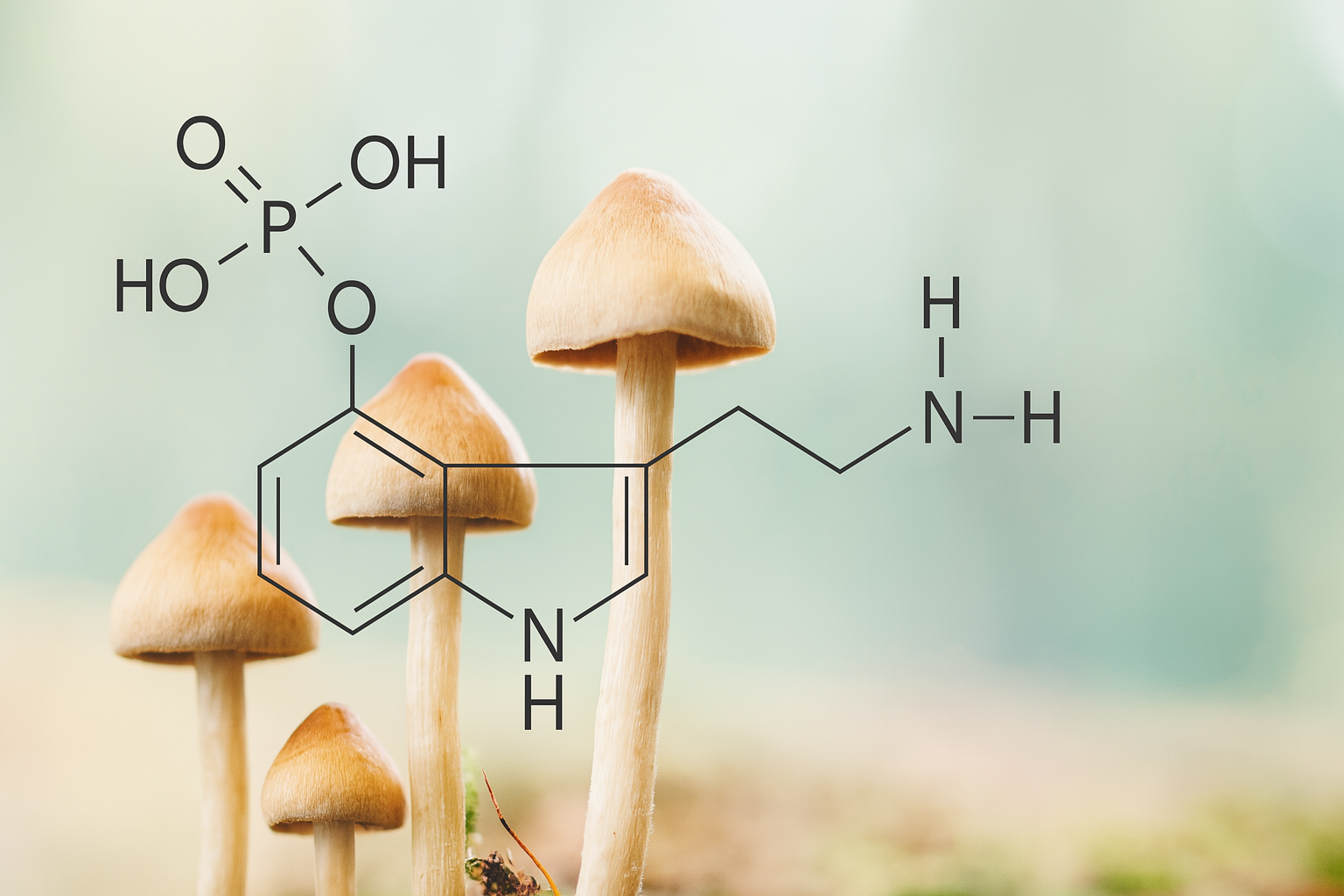

Mushrooms of all species produce a range of different alkaloids. Some are considered safe and even very beneficial to health. This is especially true for substances produced by so-called functional mushrooms. Others, however, are more controversial due to their nature of action. These include psilocybin, but also another intriguing alkaloid, also found in “magic mushrooms” – norbaeocystine. What is it? What are the effects of norbaeocystine? Are there risks associated with taking it? You will find the answers to these questions below. Please read on!
What is norbaeocystin?
Discovered in 1968, this alkaloid occurs in “hallucinogenic” mushrooms (it was detected in Psilocybe baeocystis). From a chemical standpoint, it is structurally related to psilocybin and baeocystin, serving as their precursor. It is an N-desmethyl derivative of baeocystin, meaning it lacks one methyl group on the nitrogen.
Like psilocybin, norbaeocystin exhibits some (though much lesser) psychedelic effects, influencing the perception of reality and consciousness. Like the alkaloid typical of Psilocybe species, this one is an agonist of serotonin receptors (including 5-HT2A), responsible for psychedelic experiences, but – it’s worth emphasizing – many studies suggest it does not cause hallucinations.
Sources of Norbaeocystin
Now that we know roughly what norbaeocystin is, it’s worth exploring its sources. They can be divided into natural and synthetic. In nature, this substance occurs in mushrooms containing psilocybin, including, among others, of the genus:
- Psilocybe,
- Inocybe,
- Panaeolus,
- Pholiotina,
- Pluteus.
Furthermore, it is produced in laboratories – in which case we speak of synthetic sources. In 2020, Dr. Alex Sherwood and his team developed a method for obtaining this compound in the laboratory. Parallel research was conducted at the University of Miami, where a group of scientists used genetically modified strains of E. coli bacteria for biosynthesis.
Effects of Norbaeocystin
As mentioned above, this compound interacts with the serotonin system, including 5-HT2A and 5-HT1A. At the same time, it exhibits lower affinity than psilocybin or baeocystin. It has limited ability to cross the blood-brain barrier and lower bioavailability, therefore, it does not necessarily cause effects such as hallucinations or altered perception. This has been demonstrated in studies conducted on rats.
However, the situation changes when this substance is administered with psilocybin. Then, the action of norbaeocystin produces a synergistic effect between them. It has been suggested that in this combination it can cause, among other things:
- euphoric states,
- distortions in the sense of time,
- spiritual experiences,
- joy and lightness.
However, there are studies suggesting that the effect on perception is just one of the properties of this compound. The other is related to its effect on the gut microbiome. Their results suggest that norbaeocystine may increase the diversity of bacterial flora present in this part of the digestive system. This, in turn, potentially has a beneficial effect on immune system function and mental well-being by affecting the gut-brain axis.
Risks Associated with Norbaeocystine Use
Like other alkaloids from this type of mushroom, this substance still requires further research. However, the risk of norbaeocystin, as demonstrated by tests conducted on this compound so far, is low due to its very limited ability to penetrate the brain. Only when combined with psilocybin can it intensify psychedelic effects and cause more profound perceptual alterations, including the occurrence of synesthesia – the experience of, for example, visual stimuli through other senses, including touch.
It is worth adding that this alkaloid has not been shown to cause significant toxic effects. Although this still requires research, no acute poisonings that could pose a threat to health or life have been observed.
However, it is worth bearing in mind that there are other risks associated with this and similar compounds. Namely, people who attempt to use these types of mushrooms recreationally (which, let us remind you, is illegal) may make a mistake when obtaining them from the wild. Many similar, yet poisonous, species occur in these locations.
Potential Uses of Norbaeocystin in Medicine
On the other hand, like psilocybin, norbaeocystin is considered from a therapeutic perspective. It can be introduced as a modulator of psilocybin’s effects, allowing for the creation of preparations with more predictable effects. The impact on the biodiversity of the microbiome, in turn, is seen as an opportunity to create remedies that improve overall health – both physical and mental.
Research on norbaeocystin is still ongoing
Although psilocybin is the main focus of scientists’ research, the synergy between these substances could lead to very interesting effects. However, demonstrating the safety and usefulness of this alkaloid in therapies, such as depression, still requires research. This topic will certainly appear on the blog again as new information about it becomes available to the public.