


Among the Psilocybe cubensis strains, for which you’ll find mycelium observation grow kits at Mykolaborian, are many intriguing options. One of the most interesting is the Malabar variety. Oriental, impressive in its performance, truly unique… It will be appreciated by anyone with experience in amateur mycology, as well as beginners. However, it’s worth keeping in mind that this and other P. cubensis strains are subject to certain restrictions. And this is just one of the reasons why it’s worth learning more about the development stages of mushrooms. See what they look like in the case of Malabar mushrooms.
Key Facts about Malabar Mushrooms
This strain is considered one of the “closest to nature” varieties. It originates from the Indian province of the same name, specifically the Malabar Coast, located in southwestern India. This variety grows naturally in this region, and elephant dung is an excellent source of food. Therefore, in the environment, it functions, among other things, as an organism that decomposes this type of organic matter.
These mushrooms were likely used by the local community in the past. As we know, in various religions throughout India, a state of altered consciousness is a crucial factor in communing with superhuman beings or the consciousness of the world. However, it is difficult to pinpoint the exact moment when they became “more popular” in Western societies.
The mycelium of this strain is characterized by very dynamic activity. It quickly colonizes the substrate, especially when provided with the right growth conditions. Like most Psilocybe cubensis, Malabar mushrooms thrive best at temperatures between 21° and 25° Celsius, and they are among those that can also tolerate hotter climates. This strain also fruited most effectively in these conditions.
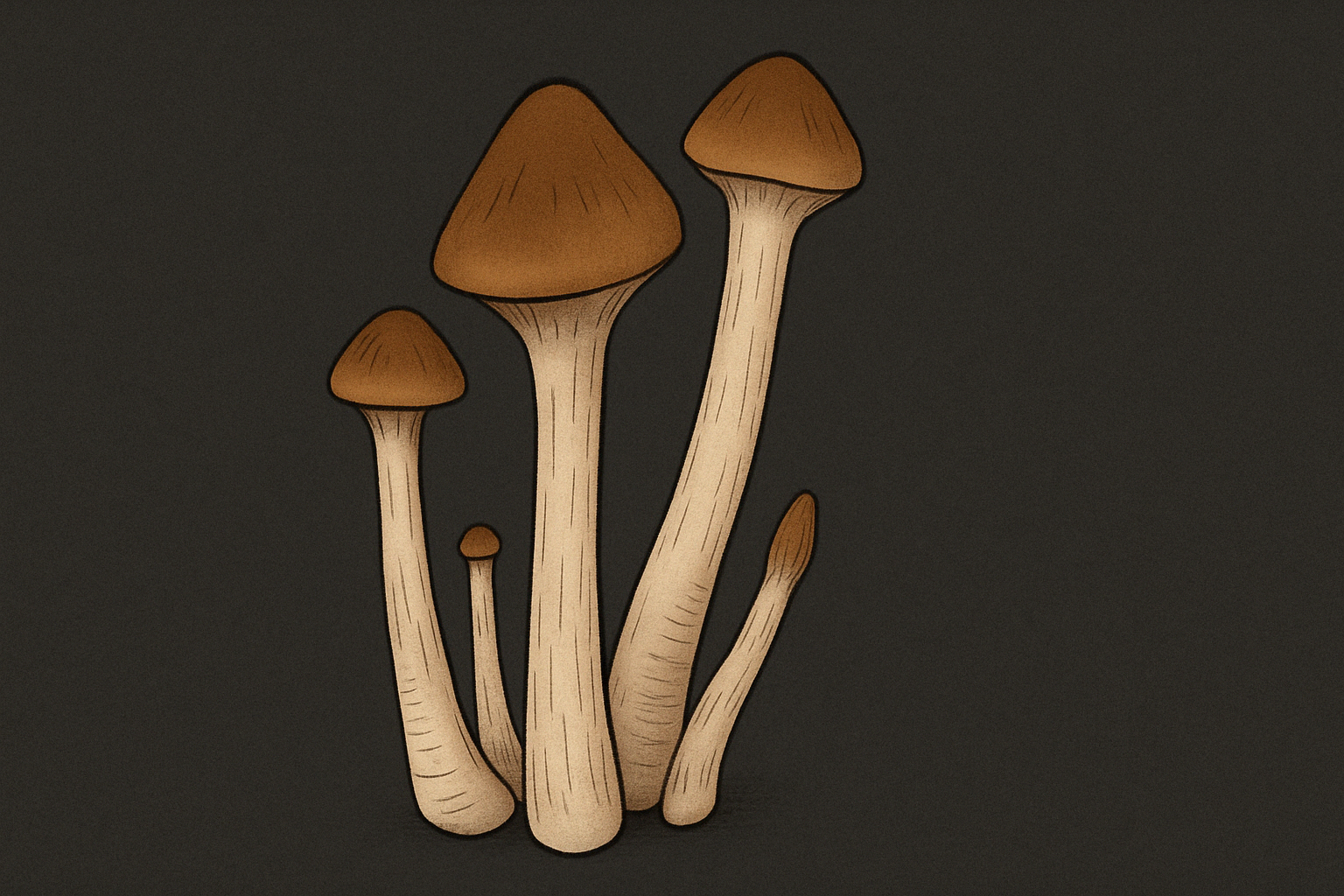
The fruiting bodies are relatively small, quite characteristic of this species. The light brown (darker in the center), regularly shaped caps grow on a narrow, quite straight (sometimes bent, but not twisted), and long stem. In older mushrooms, the edges may curl upward. When it reaches maturity, the veil breaks open, and spores are released.
What are the different developmental stages of Psilocybe cubensis Malabar mushrooms?
Now that you’ve learned more about Psilocybe cunensis Malabar, it’s time to tell you more about the different developmental stages of this and many other species. A typical cycle looks like this:
- Spore shedding.
- Mycelium formation.
- Primordia development.
- Pin growth.
- Fruit body ripening.
Let’s take a closer look at each of these stages.
Spores
Also called spores, which are shed by mature fruit bodies. Psilocybe cubensis spores are invisible to the naked eye (certainly not individually). However, mycelium develops from them – provided they have the right substrate, conditions, and food.
Mycelium
In other words, mycelium are hyphae that develop on the substrate. They are the basis of the mycelium that colonizes the substrate. The primary biological goal of their development is to form a “structure” on which fruiting bodies can grow, allowing them to continue reproducing.
Primordia
These are the mushroom primordia that indicate successful substrate invasion, mycelium maturity, and readiness for reproduction (including fruiting). The microscopic structures resemble Styrofoam balls.
Pins
“Pins” grow from primordia. These are young fruiting bodies from which mature mushrooms later grow. During this time, they require high humidity and an appropriate (stable) temperature.
Final fruiting phase
Finally, mature fruiting bodies emerge from the pins. In the laboratories where these mushrooms are cultivated, they are harvested at this point to obtain preparations for research.
What to remember when choosing a Malabar grow kit?
Although I’ve outlined the development of Psilocybe cubensis, including the Malabar variety, above, it’s important to remember that amateur mycologists working with this species can only colonize the mycelium without allowing fruiting. Why? Because that’s the law – the fruiting bodies already contain psilocybin, which is banned. However, reviews of growkit Malabar clearly indicate that it is an easy variety to grow, and you can quickly identify when the material needs to be “disposed of.” This makes it also suitable for beginner mycologists.