

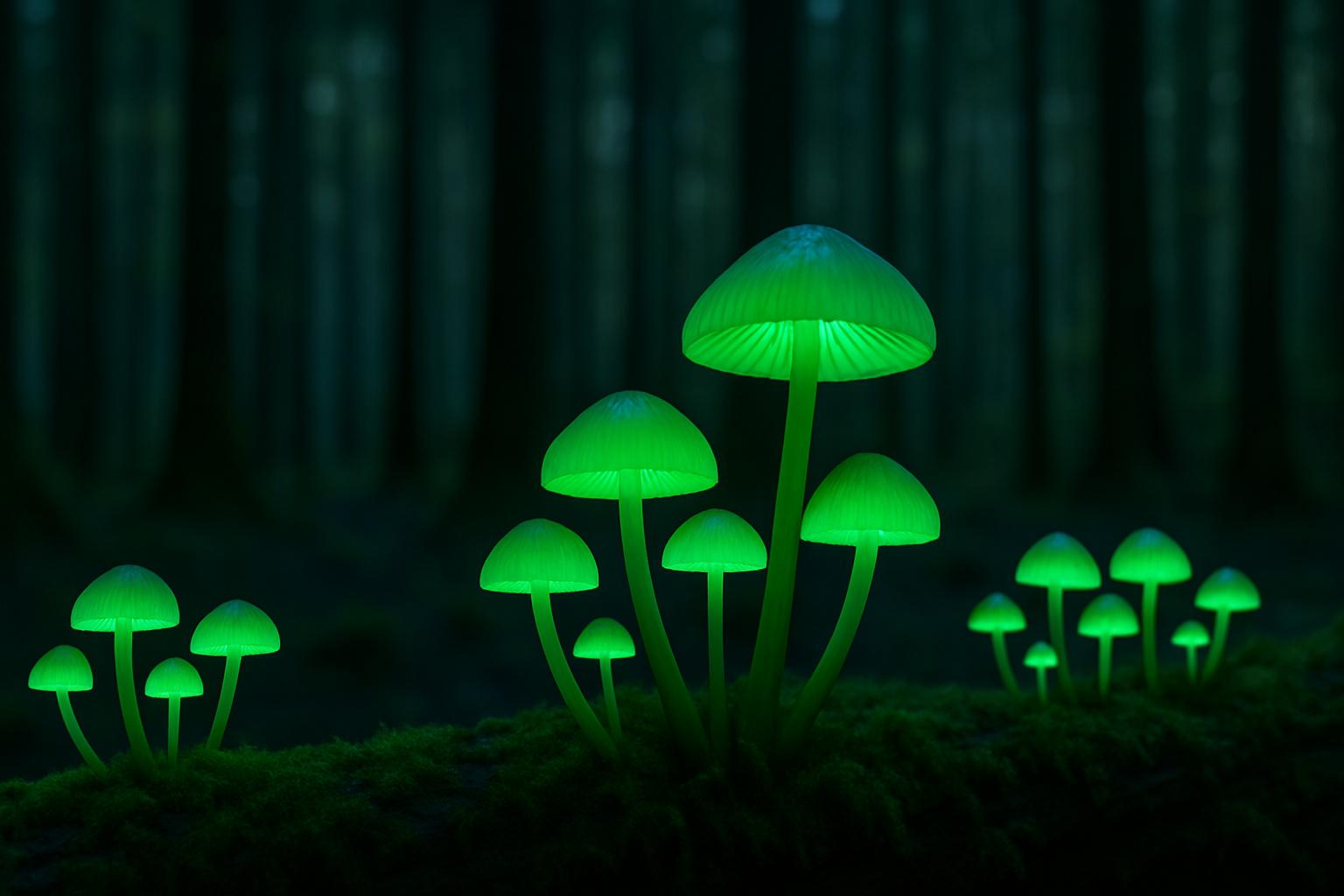

Even if you’re not interested in mycology, you’ve probably heard the story of glowing mushrooms. Indeed, some species emit light through various biochemical processes. How does mushroom bioluminescence occur? What mechanism is behind it? What are the facts and myths about these extraordinary organisms? I answer these questions below. Read on!
What is bioluminescence?
It’s the natural ability of living organisms to produce visible light. This occurs as a result of chemical reactions occurring within them. In most cases, three specific components are responsible for this:
- pigment luciferin,
- enzyme luciferase,
- oxygen.
However, this is not a rule – certain Some organisms have special glands (photophores), while others coexist with bacteria with luminescent properties.
In the context of bioluminescence, fireflies are most often mentioned. On the other hand, this ability is also often discussed in the context of fungi, including those living in dark caves. There are up to 70 (or even more!) species of organisms in this kingdom. Most belong to the Basidomycota phylum, and the most common ones include:
- Honey fungus,
- Ochraceous lycopersicum,
- Mycena chlorophos,
- Orange calyceum,
- omphalotus iludens.
It’s worth knowing that – contrary to belief – bioluminescence in fungi occurs much more often in the mycelium. In addition, appropriate environmental conditions must be met. Luminous mushrooms, as fruiting bodies, are rare. In such cases, light is most often emitted by both the mycelium and the “fruit.” As a rule, bioluminescence is characteristic of emerging fruiting bodies rather than mature ones. Interestingly, most of these organisms produce a characteristic green (and therefore consistent with the general concept) color of light.
How does bioluminescence work in fungi?
As a rule, fungi contain similar compounds to those found in other light-emitting organisms. Similar doesn’t mean the same, nor does the mechanism of light production. A crucial step is the synthesis of luciferin (in the case of fungi, it’s 3-hydroxyhispidin), stimulated by the enzyme hispidin synthase (HispS), which uses caffeic acid to synthesize hispidin. Next, hypsidin 3-hydroxylase (H3H) catalyzes the hydroxylation of hispidin, resulting in “fungal” luciferin.
Once formed, this luciferin is oxidized in a reaction with luciferase, a characteristic of fungi. This produces caffeoyl pyruvate (oxidized luciferin), and green light is emitted. Caffeic acid regeneration then occurs, during which the oxidized luciferin is broken down into pyruvic acid and, indeed, caffeic acid. Thanks to this, fungi, unlike insects or other organisms, glow with a faint but constant light.
Why do mushrooms glow?
Now that we know roughly how this mechanism works, it’s worth considering why light-emitting fungi have evolved this ability. There are various hypotheses. The main one is that it attracts insects to facilitate spore dispersal. Another theory suggests that it may be a simple metabolic or protective function. In this way, the fungi are supposed to get rid of excess biochemical energy (heat), protecting the mycelium from damage. In this way, they also rid cells of excess oxygen produced during metabolic processes.
The protective theory also suggests that they potentially deter animals that might feed on the fungus… or attract predators that feed on fungus-eating parasites. It’s also possible that they have all of the above-mentioned purposes.
Some facts and myths about bioluminescent mushrooms
Many myths have arisen around luminescent mushrooms. Some believe, for example, that since they emit light, they must cause altered consciousness. Do luminous hallucinogenic mushrooms exist? There’s no solid evidence for this. There are only isolated reports indicating it’s possible, but also unlikely.
Another myth concerns reading by such light. This refers to the case of World War I soldiers who were said to have read letters in trenches by pieces of wood overgrown with honey fungus mycelium. However, reliable historical accounts on this subject are difficult to find.
What do we know for sure? That luminous molds and other fungi could illuminate the path in mines and on dark forest trails. It’s important to note that the purpose wasn’t to improve visibility, but rather to mark the route. However, it’s likely a myth that they were used to illuminate gunpowder magazines and warehouses containing flammable substances. There’s no historical evidence for this, except for anecdotal reports.
Want to learn more about mushrooms? Follow the Mykolaborian blog!
Mushroom bioluminescence is an incredibly engaging and broad topic. While it’s undoubtedly a fascinating phenomenon, our understanding of it far exceeds the actual capabilities of these organisms. This doesn’t change the fact that it can be used for human purposes. For example, such mushrooms are being considered as biosensors for environmental pollution and for detoxification. And if you want to learn more about various organisms from the kingdom of fungi, I encourage you to follow my blog!