

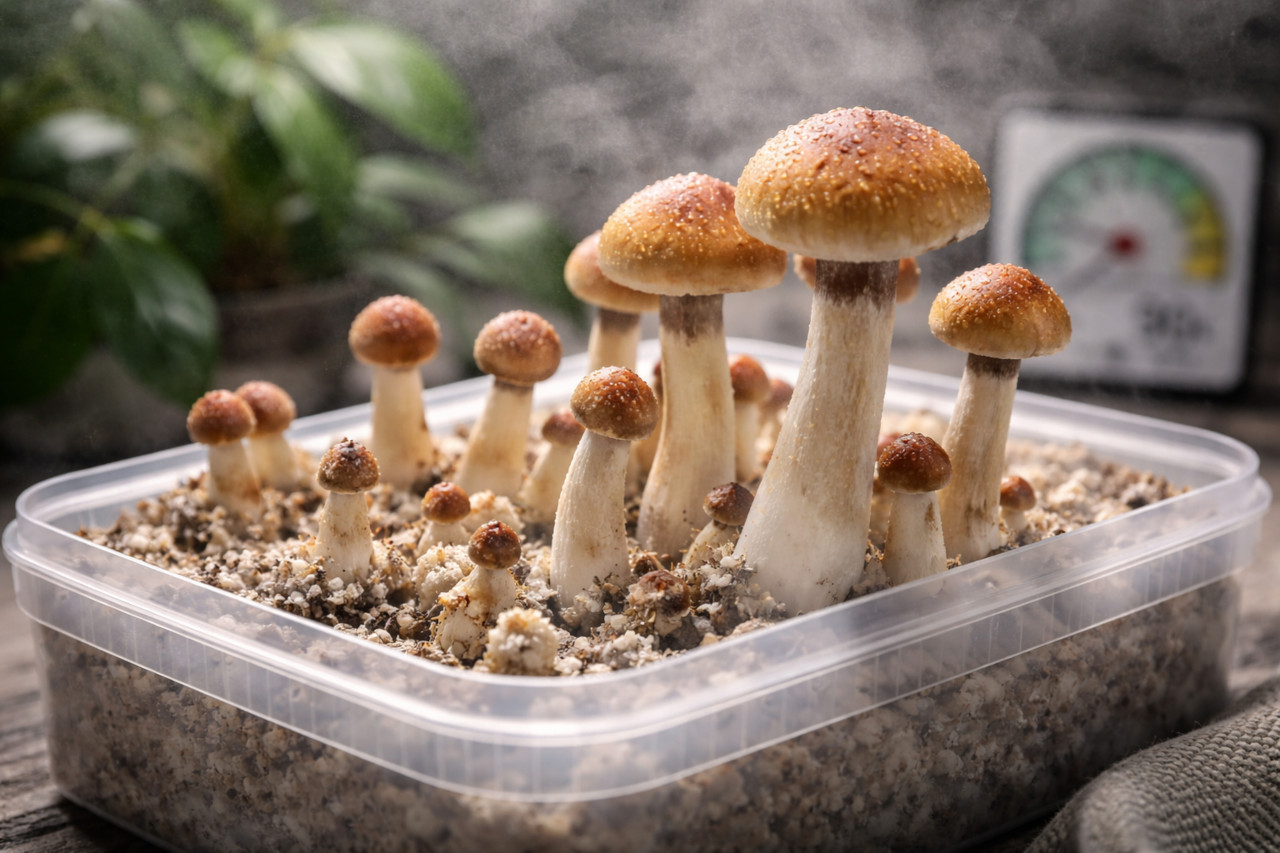

Observing functional and edible mushrooms or mycelium for microscopic examination is an increasingly popular hobby for mycology enthusiasts. However, working with such biological material requires knowledge, caution, and, as reality sometimes demonstrates, patience. Many amateurs in this field of science often wonder how quickly mushrooms grow in a grow kit. This is an interesting topic, which I discuss in this article. If you are also concerned about this and similar questions, I encourage you to read this article!
Mushrooms in a grow kit and in nature – differences affecting growth
If you are just planning to delve deeper into the world of mycology, you may have already made your first observations in nature. However, you should know that the behavior of mushrooms in the wild and in a grow kit is fundamentally different. Why? Let’s take a closer look.
Let’s start with the conditions under which mycelium “works” in nature. Whether they grow in clearings, forests, meadows, or jungles, they serve a specific function. By growing on soil, wood, and other organic matter (not always inanimate, as they can also be parasites!), they restore certain nutrients to the environment. They usually develop in the soil from spores, from which the mycelium is just beginning to germinate. It’s important to note that mycelium never operates in a vacuum. It faces very strong competition from other organisms, including other fungal species found in a given biome and microorganisms. Furthermore, their growth is dependent on the season and weather. They can either promote the development of fruiting bodies, and therefore reproduction, or inhibit them.
In a growkit, the situation is completely different. When you purchase such a package – whether mushrooms from Polish forests or those used in traditional Chinese medicine – you receive fully developed mycelium, inoculated onto a substrate. Furthermore, as long as the growkit has been properly “produced” and you handle it properly, it functions in conditions of zero competition (I emphasize – this is a desirable state, requiring careful attention to sterility). Therefore, the fungus can consume all the nutrients present in the substrate. Additionally, the conditions inside the box are strictly controlled, and if you place it in the right location, you’ll ensure uniform temperature, humidity, and ventilation – the mycelium will work very intensively.
Naturally, the situation is slightly different when inoculating liquid cultures. In this case, you’re running a grow kit from the moment the fungus begins to colonize the substrate. This requires more time than with regular grow kits.
What conditions promote faster mushroom growth in a grow kit?
Equipped with the above knowledge, you can surely see how much depends on both a good supplier and the person handling the grow kit. With full-auto products, the process is automated to the maximum, which significantly improves the ease of observation. The user simply needs to place the pack in the appropriate location.
How long the grow kit will grow depends on where it is placed. Therefore, it’s worth finding a quiet space for it where the temperature is stable. Most species thrive best within a temperature range of around 18-24°C. Too high a temperature increases the risk of metabolic stress and infection. Too low a temperature, however, causes the fungus to hibernate, and its metabolism to slow down.
Another issue is humidity. The optimal temperature for mushrooms is around 80-95%. This means they need a fair amount of moisture in the air, but you absolutely shouldn’t “flood” the mycelium with water. Stagnant liquid can encourage the growth of bacteria and mold. Too low a humidity, on the other hand, slows the development of fruiting bodies and the mycelium itself.
Furthermore, the ventilation of the container also affects the rate of colonization and growth of fruiting bodies. Proper development requires a sufficient amount of oxygen, while excessive amounts of carbon dioxide can “suffocate” the fungus, causing it to develop long stems with small caps. Furthermore, mycelium development is disrupted, and instead of a strong structure, it often forms a chaotic fluff.
It’s also important to remember that light affects the rate of mycelium growth. However, it doesn’t act like light does in plants, which draw energy from it. However, it stimulates the fungi to fruit. It therefore constitutes a so-called “light-induced” effect. Morphogenetic signal.
Differences in colonization and growth rates depending on species and cultivar
Another factor must be considered – the species or even cultivar “inhabiting” a given growkit determines the colonization and fruiting time. Oyster mushrooms and some tropical species, for example, mature very quickly. In their case, harvesting occurs after as little as 10 days, sometimes after 2-3 weeks. Growth time can still vary considerably between hybrids. The MVP grow kit, despite its super-fast colonization, has a theoretical ripening period of approximately two weeks. Most mushrooms, however, require about 3 to 6 weeks. Shiitake mushrooms, on the other hand, need 1-2 months (in packs).
It’s important to remember that mushrooms come in different varieties. The Psilocybe cubensis mycelium, intended for microscopic examination, has variants that work either very quickly (even instantly) or “consume” the substrate quite slowly. However, this species can still be classified as a faster mushroom. And how long do Psilocybe cubensis mushrooms grow from a grow kit? Typically, from the moment the mycelium “wakes up,” fruiting bodies can appear after up to 10 days. One example of a particularly dynamic strain is the McKennaii Ready-To-Grow bag, which is characterized by super-fast colonization. Slower varieties take a few weeks, usually three.
What is the process from inoculation to fruiting?
I’ve devoted a lot of space to how mushrooms develop in a ready-made grow kit. But how long does colonization and fruiting take if we’re just introducing mycelium to the substrate? I’ll skip preparing the substrate itself, as that’s a separate topic. Let’s look at development from the moment of inoculation, when the mycelium is just beginning to colonize. This period usually takes about 3 to 5 weeks. Once it has taken up most of the medium, fruiting can be induced.
During the time until the hyphae develop and form a “cake” on the grain or other substrate, the most important thing is to check that everything is going “according to plan.” At a certain point, once it has taken up the entire substrate, the first buds will begin to form. The concept of “flush” is important in the context of fruiting body development. It’s a type of synchronized fruiting wave, during which the mycelium activates multiple growth points, and mature specimens develop within a short, intense window of time. After harvest, there’s a regeneration phase, followed by another flush.
And how long does the first flush of the growkit last? Typically, it takes 3 to 7 days from the appearance of pins to harvest. The active period of initial fruiting, let’s call it, is completed in 5-10 days. It’s important to remember that this also depends on the mushroom species and variety! For those curious – from the moment Psilocybe cubensis buds appear, it usually takes 3 to 7 days, during which time pinnae appear for 1-2 days, fruiting bodies grow rapidly for the next 4 days, and mature within 24-48 hours.
Mushrooms require patience and stable conditions
If you’re working with a grow kit, you can usually expect much faster results. Many species of the fungi kingdom will typically produce their fruits within 2-3 weeks. However, starting by inoculating mycelium cultures onto the substrate requires much more patience. This is due to the fact that mycelium is only just beginning to become domesticated under specific conditions. At the same time, it’s important to remember that some species, such as the aforementioned Psilocybe cubensis, can only be produced by licensed laboratories. Amateur mycologists can only admire the beauty of the mycelium of this incredible species.