

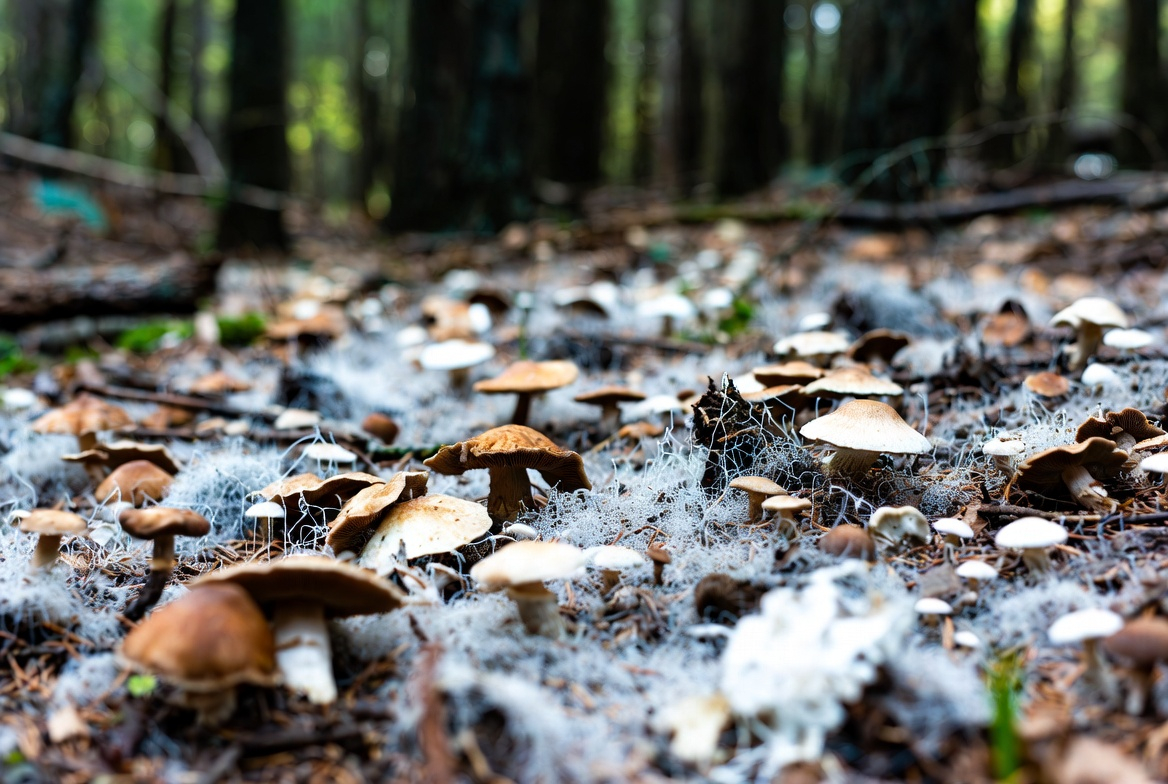

Mushrooms are fascinating organisms, constantly surprising amateur observers and scientists who have dedicated their lives to them with their behavior. One of the biggest mysteries that plagues mycology enthusiasts is why mycelium seems to grow and colonize randomly, sometimes even chaotically, and sometimes develops only in one place. Contrary to appearances, these organisms have a “larger plan” behind it. If you want to learn more about this topic, I encourage you to read this article now.
What influences mycelium development in a grow kit?
In any situation, atmospheric conditions, including humidity and temperature, are paramount. In a natural environment, however, mycelium has almost unlimited growth potential. That is, if circumstances favorable to its growth occur, it can grow literally anywhere – seeking food that will nourish the fungus or fleeing from toxins that could harm it.
On the other hand, in nature, these organisms compete with other “competitors” inhabiting the environment. From other fungal species, to bacteria, to predators. This forces the mycelium to act aggressively. It’s its “to be or not to be.” Furthermore, it has various energy sources, which, on the one hand, promotes growth, but on the other, requires adaptation and the production of a greater number of various enzymes.
In a growkit, things are different. First and foremost, the space for growth is limited, which has its advantages and disadvantages. The disadvantages of such an environment include potential contamination. If contaminated, mycelium has nowhere to escape and is quickly at risk of being overtaken by an aggressor. On the other hand, a closed environment means zero competition (unless contamination occurs). This allows it to function at its own pace, but also becomes more sensitive to sudden changes. Even a difference of 1-2° Celsius can affect its growth rate. At the same time, “growth packets” provide it with a consistent source of energy, which accelerates its metabolism.
How fast do mycelium and mushrooms grow?
First of all, the growth rate of both the vegetative part of the mushroom and the “reproductive organs” (read: fruiting bodies) is variable and depends on various factors, including atmospheric conditions. This process can be compared to a rocket launch. For a long time, little or, to put it another way, a lot happens, but beneath the surface, sometimes giving the impression that the launch will never take place. However, at a certain point, event after event, the process accelerates.
The situation is similar for members of the fungi kingdom. Naturally, the conditions provided by growkit determine how quickly the mushrooms grow. Provided they are provided with the right temperature, around 21-24° Celsius, growth can become rapid at a certain point.
Colonization is preparation for launch. During this time, the mycelium grows on average at about 2 to 7 mm per day. Proliferation on the substrate takes about a week or two. During this time, white fluff appears on the thallus. Depending on whether it is concentrated or scattered, fruiting occurs earlier or later, respectively.
When this time arrives, primordia, commonly called pinnae, form. They usually form within 2-3 days, and the process continues for about 5 days. After this period, they begin to grow rapidly, doubling in size in as little as 24 hours. The fruiting body reaches full maturity in 4 to 7 days.
Ultimately – how long does the mushroom grow from the moment the mycelium is stimulated until the full fruiting body develops? It is estimated that this process typically completes within 16-30 days. However, it is important to remember that it is influenced by various factors, including temperature, humidity, and oxygen availability. If you notice a lack of fruiting of the mycelium, it may indicate:
- too low or too high a temperature,
- too high a CO2 concentration,
- if the smell and color change – probable contamination.
Is this normal? That the mycelium grows in one place?
Many people are concerned about another symptom. Namely, that the mycelium only grows in one place. Is this a bad thing? Well… no, or at least not always. This is because the mycelium seeks optimal conditions for growth and “invests” its energy where it’s most profitable. Therefore, it may grow more towards the interior of the room (because temperatures tend to be lower towards a wall, especially an exterior wall) or choose a section of substrate that is ideally moist for it. Moreover, even the arrangement of the grow kit sometimes determines how the mycelium will grow. This is due to the concentration and circulation of carbon dioxide and oxygen within the packaging.
Naturally – if you notice this type of behavior in the fungus, it’s worth observing it more closely. Mycelium growth in one spot can also be a response to a yet-to-be-seen bacterial contamination, causing a change in pH and the release of toxins harmful to mycelium.
Mycelium is a delicate, yet intelligent structure
Regardless of the type of mushrooms you have in your grow kit, remember that they are guided by one main goal: survival. They seek optimal development conditions, calculate when something is profitable, and defend themselves against potential threats. So if you notice that the mycelium is growing “strangely,” keep an eye on it. Also, pay attention to its surroundings – temperature, ventilation, and potential sources of contamination. This will help you better understand how it works.