

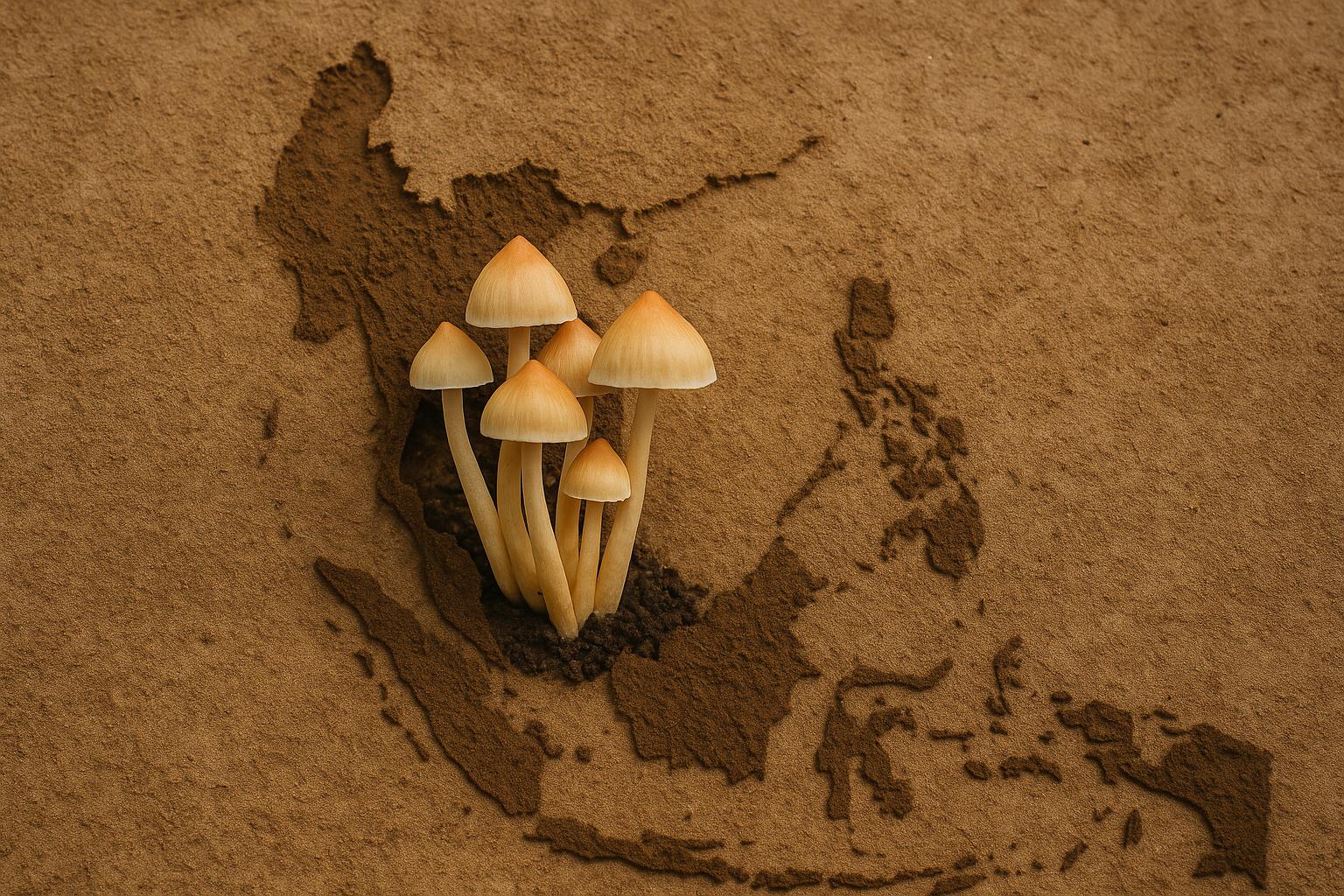

Usually, when we talk about “exotic” in the context of psilocybin mushrooms, the African Psilocybe natalensis comes to mind. Meanwhile, Southeast Asia is a true gold mine for microscopic enthusiasts. Which species of the Psilocybe genus are among them? What interesting things can you see on the glass, under the microscope’s eyepiece? I encourage you to read it!
Exotic Mycology, or the Treasures of Southeast Asia
Although we usually associate the world of psilocybin mushrooms with the tropics of Central and South America, a treasure trove of diversity when it comes to this type of organism is found in the regions of Thailand, Cambodia, Laos, Vietnam, and other countries in Indochina and beyond. Psilocybin mushrooms from Asia are much less well-known, even among mycologists. However, they are species that provide incredible experiences from microscopic observations.
Which of them are the most interesting and best known? These include:
- Psilocybe subaeruginosa ,
- Psilocybe samuiensis ,
- Psilocybe arengipes ,
So what Can exotic mycology reveal its secrets to observers? Check it out now!
Psilocybe subaeruginosa
For those interested in exotic varieties of psilocybin mushrooms, this species has a lot to offer. The blue-green cap is a “medium-sized” member of the Psilocybe species:
- The cap is approximately 1.5 to 5 cm in diameter; it varies from conical to convex with a small umbo in the center; it is characterized by a smooth surface; it has translucent grooves on the edges; Color ranges from light to dark brown, absorbs water strongly, but becomes grayish-white when dry;
- The stipe is up to 12.5 cm long and relatively thin – 2 to 5 mm thick; slightly thicker at the base, but otherwise even; hollow inside; whitish with brown streaks, and turns blue when damaged.
What can we see under a microscope? The spores are purple-brown. They are ellipsoidal in shape, and measure up to about 15 μm long and 7.7 μm wide. The basidium (basidium) is four-spored (rarely two-spored). The pleurocystidia are fusiform-ventricose with terminal appendages with an elongated neck. They usually measure a maximum of 47 μm in length and 16.5 μm in width. The cheilocystidia are also fusiform-ventricose, measuring up to 29 ✕ 11 μm.
Where is Psilocybe subaeruginosa found? They typically grow in soils rich in woody debris. They are found on leaf and twig remains, among other places. They prefer sandy soils. Although they are primarily found in Australia, Tasmania, and New Zealand, they are also occasionally found on the islands of Southeast Asia.
Psilocybe samuiensis
Another intriguing species of the genus Psilocybe found in Southeast Asia is Psilocybe samuiensis, or the Samui Bald Eagle. It grows on Koh Samui, a relatively small, isolated habitat where it may have evolved independently of its “cousins.” What are its external characteristics?
- cap 7 to 15 mm in diameter, convex to conical in shape with a small, distinct peak; sticky with a membrane on the surface; stains reddish-brown (when wet), lighter when dry;
- stipe relatively short – grows to 6.5 cm tall and 1.5 cm thick; even, slightly bulbous at the base, hollow inside; whitish in color with distinct white fibers.
What does microscopic analysis of these fungi show? The spores are rhomboidal in shape, measuring up to 12.8 µm in length and 8 µm in width. The basidia are four-spored, while the pleurocystidia are scattered and ventricose.
Psilocybe arengipes
Although found primarily in Japan, Psilocybe arengipes also appears in a few localities in Southeast Asia. Its distinguishing features include:
- caps, usually up to 5 cm in diameter; young caps are usually conical (sometimes bell-shaped), and with age they open to a broadly convex cap (sometimes flat with an umbo); when moist, they are dark brown, and when dry, they turn dark gold, honey, or sometimes mustard; smooth surface, rolled edges;
- stipe medium long, up to 80 mm; thin, up to 4 mm; even and widening at the base; in the upper half, from white to shades of yellow, becoming brown with white fibers in mature caps. at the bottom – it has a characteristic silvery tint (hence the Latin name – silver foot); sometimes it has remnants of the veil.
The dark, purple-brown, ellipsoidal spores measure up to 9.5 µm in length and 4.5 µm in width. The basidia have four spores. Cheilocystidia typically measure 12-25 by 5-8 µm.
The Fascinating World of Exotic Mycology
These are just three of the many psilocybin mushrooms (not necessarily from the genus Psilocybe) found in Southeast Asia. There are certainly many more waiting to be discovered – after all, species appear and disappear daily, and mushrooms are remarkably resilient when it comes to mutation and evolution. Although they belong to the same “family,” they can yield interesting insights when observed under a microscope. So if you ever come across the mycelium of one of them, you have a real treasure on your hands and it’s worth examining!