

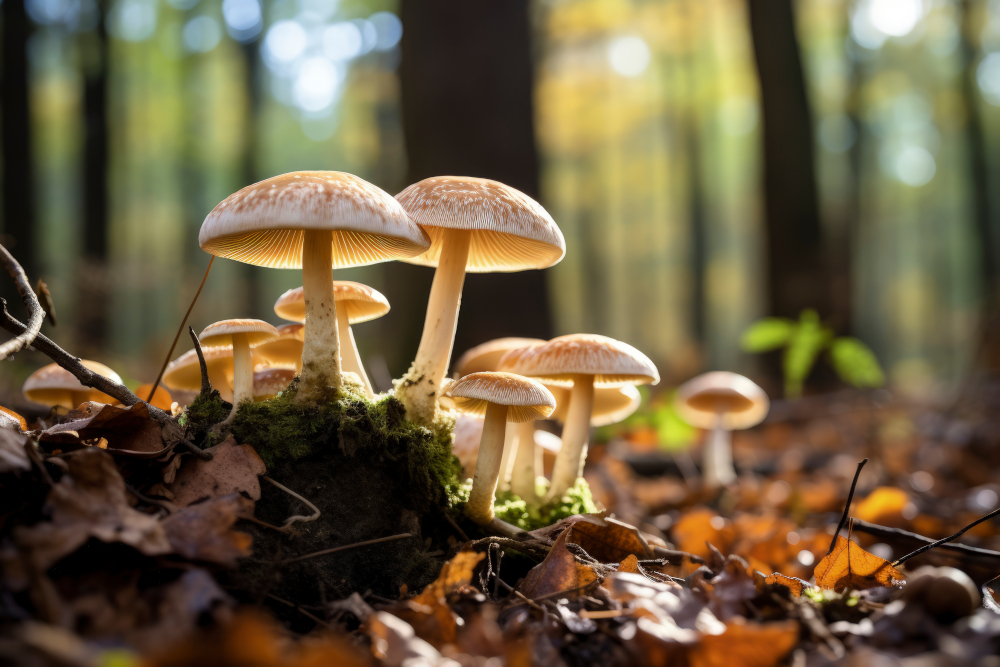

When people talk about psilocybin mushrooms, or “magic mushrooms,” they usually mention various strains of Psilocybe cubensis, including Nutcracker Growkits or El Choco Liquid Cultures. This is hardly surprising – Psilocybe cubensis is one of the most frequently studied mushrooms containing these alkaloids in labs. They are also eagerly studied by mycology enthusiasts, intrigued by the growth of their mycelium. Some forget that Europe, including Poland, also has its own “psilocybin” representatives. Psilocybe semilanceata is a distant, less exotic (at least for us) cousin of this mushroom. In this article, I’ll tell you more about its characteristics and the habitats it most often grows in. I encourage you to read on!
What is Psilocybe semilanceata?
Psilocybe semilanceata belongs to a species of mushrooms in the family Psilocybe semilanceata. It has been known for years in European history and beyond. It was first described in the late 19th century by Elias Fries (it was still known by a different name back then). We know it as Psilocybe lanceolata thanks to Władysław Wojewoda, who described it in 1987.
In the world of mycology, it is considered not only for its appearance (which I will discuss more below), but also for its effects. Due to its characteristic alkaloid content, it is classified as a psilocybin mushroom. This has a number of implications. What are they?
On the one hand, it attracts the interest of scientists, including medical specialists. Psilocybin, as I have described several times on the blog, is seen as a substance potentially helpful in combating various mental health ailments – from depression, through PTSD, to addiction. However, research on it is still ongoing, and more information can be found online (and on this blog), which I recommend to anyone interested in the topic.
On the other hand, psilocybin in certain doses triggers specific reactions. Consumed psilocybin, both fresh and dried, can cause perceptual disturbances, causing hallucinations and distorted vision. Therefore, users may – almost literally – see sounds. It is worth noting that the possession of products containing this compound is prohibited. It should be emphasized that only the fruiting bodies produce these alkaloids. Therefore, growkity or liquid cultures containing mycelium of these species are perfectly legal.
However, the criminalization of possessing these organisms doesn’t bother some people. Some people seek them out in nature on their own, sometimes risking their health and lives. The Psilocybe lanceolata is similar to other mushrooms, not only inedible but also poisonous. And what does this species look like? Find out below!
What does a Psilocybe lanceolata look like?
While exploring forests, fields, and meadows, you might encounter many similar-looking mushrooms. More than once, someone has suffered a painful burn, mistaking a kite for a death cap, or – slightly less dangerously – a gall mushroom for a bolete. And what about a Psilocybe lanceolata? How can you recognize this mushroom from others?
It’s worth noting that the fruiting bodies differ from those produced by Psilocybe cubensis grown in licensed labs. In the case of natural mushrooms, we’re dealing with specimens growing on very thin, often long stems (from 3 to 12 cm in length and up to 2 mm thick). The crown is a conical cap with a sharp apex (diameter from 0.5 to 2.5 cm).
The color of the mushroom’s “cap” depends on a number of factors, but primarily on its age and the surrounding humidity. For this reason, it ranges from chestnut brown to pale yellow. Sometimes, gills can be seen through the cap (if very wet). They, in turn, have a khaki shade, sometimes purple or bordering on black. Psilocybe lanceolata usually has a moist surface and may appear covered with mucus. This is somewhat true, and these mushrooms also stain blue, which is a result of the presence of psilocybin. This is one of the most characteristic signs that you’re dealing with this species.
Optimal Environmental Conditions for Psilocybe lanceolata
It has been suggested that these mushrooms appreciate moist substrates. They require decaying organic matter to grow (they are saprotrophs), which they convert into simple compounds. The period of fruiting body development itself indicates that this species prefers warmth. Therefore, it is usually quite sheltered from the wind (it grows, for example, in tall, wet grasses or in soil rich in organic debris, including animal feces, which generate heat through bacterial activity).
For this reason, it is most often found in areas such as pastures and meadows, and field edges (but not in the fields themselves, as harrowing destroys the mycelium). It can also be found on forest edges, roadsides, and in orchards. Because they grow mainly in thickets (less often on mosses), they are quite difficult to track down.
Natural occurrences of the European Swordtail in Poland
Globally, the European Swordtail occurs in various locations around the world. In Poland, however, it is believed that it grows naturally in upland and mountainous areas. For this reason, it can be found in the Sudetes and Carpathians. It also inhabits the wetter and warmer regions of our country, including: Białowieża, but also in floodplains and areas surrounding larger rivers, especially where there are farmlands nearby.
Is Psilocybin Scepter’s Cap legal?
Do you already know what Psilocybin Scepter’s Cap looks like and where it grows? When should you pick this mushroom? Well… generally speaking, you shouldn’t. Firstly, it’s easy to confuse it with similar species. Secondly, as I mentioned above, it’s illegal. Possession of psilocybin mushrooms, including Psilocybin Scepter’s Cap, is prohibited by law in Poland. While it may seem absurd that “gifts of nature” are subject to severe restrictions, that’s how the law works. So, if you see a fully grown bald eagle, simply avoid it or take a photo of it and leave it alone.