


In the world of mycology, new varieties of mushrooms are constantly emerging, including those of the Psilocybe genus. Dozens of interesting strains of Psilocybe cubensis have emerged, many of which have been hailed as revolutionary and guarantee incredible experiences from professional laboratory research and observation of their growth by amateurs. Among the trending varieties are Cambodian mushrooms. What exactly are they? What do they look like? Under what conditions do they grow? And are they really as unique as some try to present them? I encourage you to read it now.
Cambodian Mushrooms – What Are They?
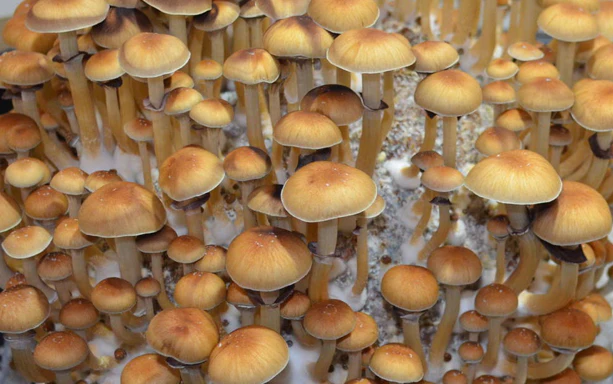
Let me start by explaining what Cambodian mushrooms are. They are a variety of Psilocybe cubensis that grows in Cambodia – a remote, jungle-covered country where it has had excellent conditions for growth. In terms of its morphology, its mycelium produces fruiting bodies that are truly exemplary. Their stems are long and medium-thick. The caps, in turn, are small to medium-sized and quite regular in shape – initially bell-shaped, and later, as they mature, umbrella-shaped. They are noticeably lighter at the edge, and darken to a brownish hue closer to the prominent wart. The mycelium is said to be quite prolific, which is considered one of the strengths of this strain.
John Allen discovered Cambodian mushrooms during his travels in Cambodia. This strain grows alongside Copelandia Cambodginiensis and, like other Psilocybe cubensis species, naturally favors pastureland areas due to their abundance of animal excrement. Interestingly, Cambodian mushrooms were discovered near Angkor Wat. Is that why this majestic temple was built in this particular location? We’ll never know for sure, but we can only speculate and let our imaginations run wild.
In what conditions do Cambodian mushrooms grow?
The mycelium and fruiting bodies of Psilocybe cubensis require quite warm and humid conditions. Cambodian mushrooms also prefer these, which is not surprising considering the climate in Southeast Asia. However, the heat and humidity of the rainforests in this region have shifted the optimal parameters higher than other strains. This means that this strain tolerates temperatures best between 29° and 33° Celsius. Its mycelium generates a lot of heat during growth, so fruiting bodies grown in the laboratory should generally have no problem growing. However, a shift in temperature tolerance has made it less tolerant of cold.
Many mycologists point to the rapid colonization and high yield of this strain. Fruiting begins after just 10 days, and fruiting bodies mature on the 25th day after cultivation. In laboratory conditions, they don’t grow well on grains, but they do exceptionally well on compost and manure, which can be quite a challenge for home mycologists.
Cambodian Mushrooms – Are They Special?
Many researchers who test this variety and observe it under a microscope emphasize its uniqueness as “super strong” and “energizing.” However, in light of the facts mentioned above, are Cambodian Mushrooms really that special? I dare say, not at all. And let me explain.
When it comes to rapid mycelium colonization, it’s enough to mention the Golden Hawk strain, which is characterized by rapid growth in standard Psilocybe cubensis conditions (i.e., temperatures between 21° and 25° Celsius). The same is true for MVP, which is also characterized by incredible fruiting yields. It’s not without reason that it’s called Most Valuable Producer. It’s not clear, but it’s been suggested that for researchers working in laboratories on psilocybin, the Cambodian strain likely remains of little value, as it may contain smaller amounts of this substance than, for example, standard PE.
Cambodian or other Psilocybe varieties?
For the reasons mentioned above, I believe that Cambodian mushrooms are nothing more than a marketing product based on their exoticism and interesting history associated with, among other places, Angkor Wat. However, when it comes to observing mycelium and conducting psilocybin research by specialists, other Psilocybe cubensis varieties are much more attractive, including Golden Teacher, Yeti Full Auto, and others. You can find their grow kits and liquid cultures in my store.