

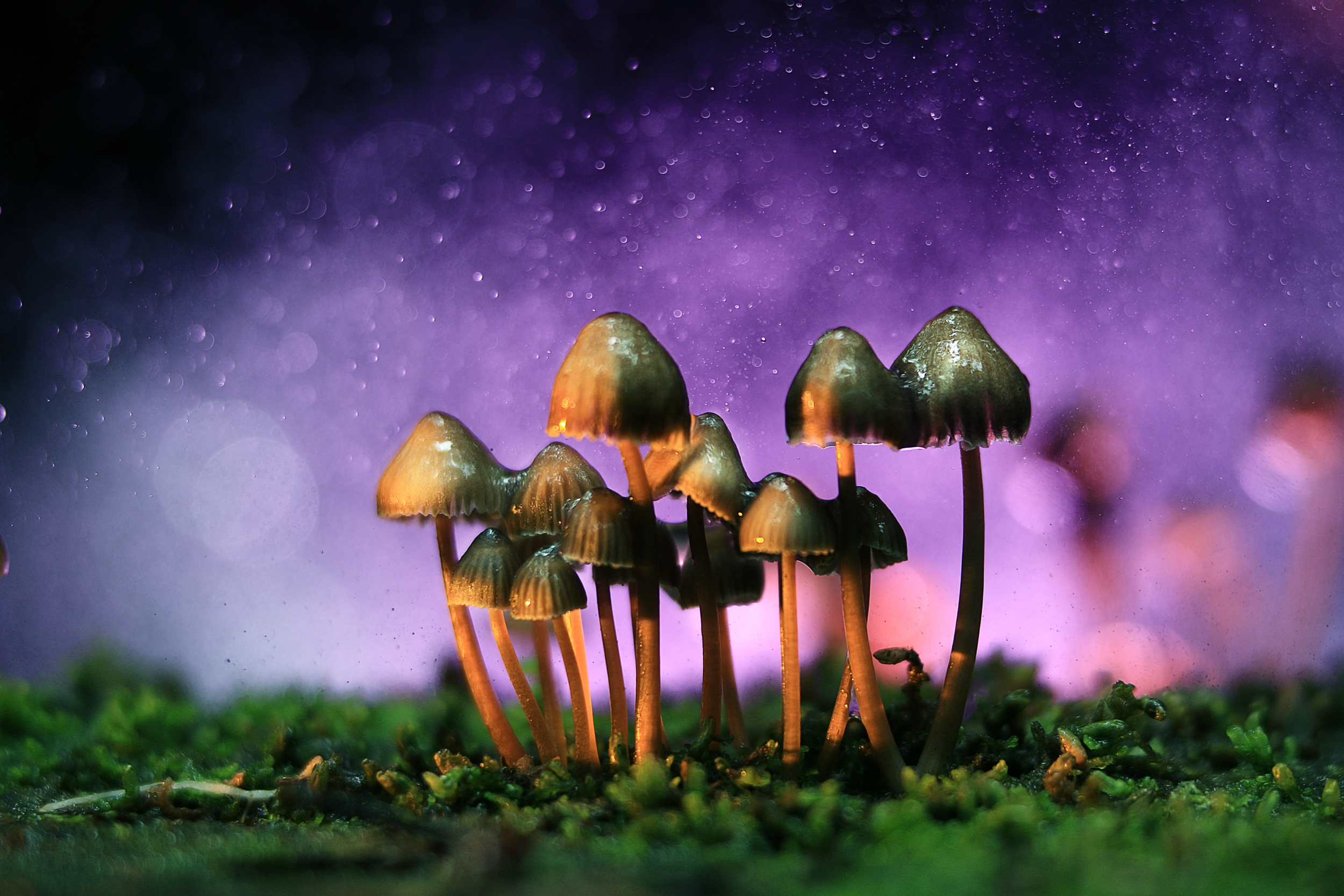

Hallucinogenic Mushrooms in Poland
Hallucinogenic mushrooms are found all over the planet. In Europe, including Poland, there are also species containing substances with hallucinogenic and intoxicating properties. Although not numerous, some are quite common. What hallucinogenic mushrooms grow in Poland? You can find out more in the article below. Read it now!
What makes mushrooms hallucinogenic?
Compounds contained in their fruiting bodies are responsible for this effect. The most potent is psilocybin, which has a psychedelic effect rather than a hallucinogenic effect. When taken, the senses are sharpened and the response to stimuli is significantly increased. Perception of reality also changes.
Sensitivity to light increases, and colors become more vivid. The contours of objects seen may also change. Extreme emotional states, ranging from euphoria to depression, can also occur. On the other hand, artists who have experimented with them in recent years have often emphasized that they have been more inspired to create, and scientists are currently working on using psilocybin, produced by, among others, hallucinogenic mushrooms in Poland, to treat various illnesses.
And what kind of hallucinogenic mushrooms are found in Poland? Find out below!
Psilocybe semilanceata – the lanceolate mushroom
This mushroom belongs to the same family as the most popular Psilocybe – cubensis. Psilocybe semilanceata is characterized by a small cap, 1 to 2 cm in diameter, which, when fresh, is moist and slightly sticky. It is olive to light brown in color. It sometimes has darker spots (sometimes dark olive or bluish green). It has an obtuse conical shape, which may become bell-shaped with age.
Its gills are quite wide, narrowly attached to the stem. Light brown, darkening over time. The cap is held on a thin, yet quite long stem, measuring up to 3 mm in diameter and up to 15 cm in length. Usually lighter than the cap, tending to a light ochre color.
Deconica (Psilocybe) montana – black-brown Psilocybe
When discussing hallucinogenic mushrooms in Poland, it’s worth mentioning the second of the two species of Psilocybe in our country that produce psilocybin. Deconica montana, also known as Psilocybe montana, or black-brown Psilocybe, is this mushroom.
Its cap is small, measuring approximately 0.7 to a maximum of 2 cm in diameter. Initially obtuse-conical, it later becomes convex. When fully mature, it can be completely flat. The edges are initially incurved, but with time, they straighten. When dry, it has a brown color, but with moisture, it changes to dark brown or even mahogany brown. Its gills are dense, descending to the top of the stem. Interlamellar interlamellae are also characteristic. Initially, they are dark brown, later turning a dirty medium brown.
The stem grows no higher than 3 cm and has a diameter of up to 2 mm. Cylindrical and straight, sometimes wavy, it is full and hard in young fruiting bodies, softening in mature ones. Its typical feature is a fibrous, evanescent veil.
Amanita muscaria – Fly Agaric
Would anyone expect that these relatively common mushrooms in Poland are hallucinogenic? In addition to poisonous alkaloids, it has been suggested that they may contain bufotenine, a substance similar in action to psilocin, and DMT. It’s worth mentioning that the toxic effect diminishes after drying.
The red cap is characterized by white patches (from the remains of the veil). It can reach up to 20 cm in diameter. Initially, it’s spherical, but over time, it becomes flat with a slight depression in the center. The usually smooth surface (slightly corrugated in mature specimens) can become sticky after rainfall. The gills are dense, free, white or pale yellowish. The stem grows up to 20 cm tall and is cylindrical, up to 3 cm in diameter. In mature specimens, it becomes hollow. It usually has a white ring.
Where are hallucinogenic mushrooms most common?
Pysiczki, or at least hallucinogenic mushrooms in Poland, belonging to this family, most often grow on organic debris in forest clearings and sometimes in pastures. They usually appear in clusters close to each other. The situation is slightly different for the fly agaric, which prefers coniferous and mixed forests. It can often be found under silver birch.
Hallucinogenic mushrooms in Poland – easy to confuse!
It’s worth remembering that only experienced mushroom pickers know, or at least are almost certain, what specific mushrooms look like. Unfortunately, sometimes tragic mistakes happen. Hallucinogenic mushrooms are no different here. Some of these species are easily confused with others.