

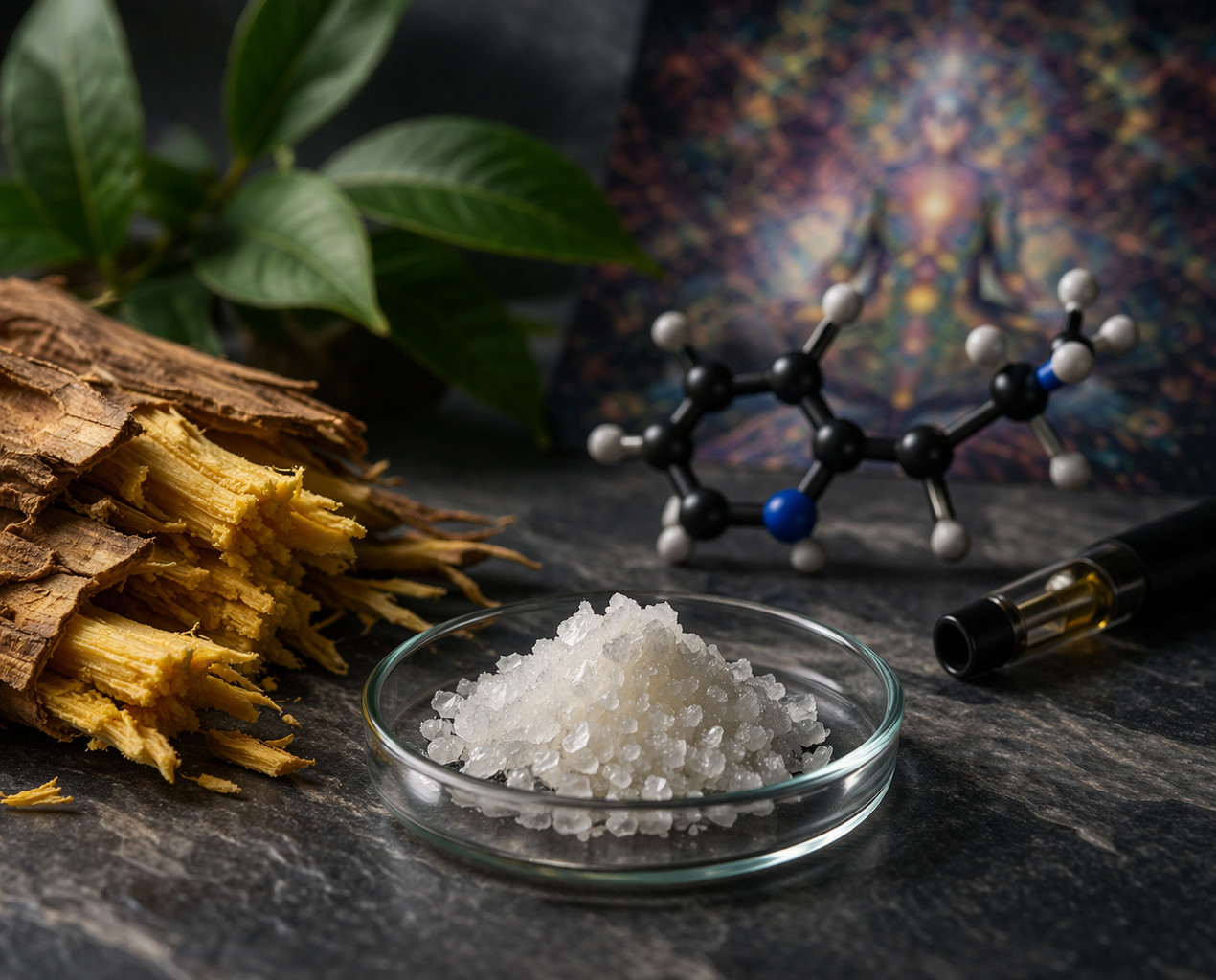

Substances with psychedelic effects are increasingly being scrutinized by scientists, who see them not as a threat but as a potential ally in the fight against various ailments. There’s talk of using them to combat depression and PTSD, among other things. DMT, for example, belongs to this group. What is it? How does it work? I’ll explain in this article. I encourage you to read it.
What is DMT?
DMT is—specifically—N,N-dimethyltryptamine. It is a classic serotonergic psychedelic, a psychoactive substance that produces effects by affecting the serotonin system in the brain. In other words, it’s a serotonin analogue, influencing the way we process information. It’s a small, lipophilic (i.e., fat-soluble) molecule that easily crosses cell membranes and—more importantly, in the context of its effects—the blood-brain barrier.
Since its structure resembles serotonin, it is an agonist of serotonin receptors (primarily 5-HT2A). It also has the ability to activate intracellular receptors. For these reasons, among others, it is believed to have potentially neuroprotective effects and regulate cellular stress.
Furthermore, it has the ability to increase brain plasticity. This is an important factor, for example, in developing new habits or breaking old addictions. More on how DMT works later in the article.
DMT should not be confused with psilocybin, another naturally occurring tryptamine associated with selected mushroom species. Mycology enthusiasts interested exclusively in observing the early development of Psilocybe cubensis mycelium can explore our Ready-To-Grow bags.
What is the origin of DMT?
It’s worth knowing that DMT occurs in many different organisms. Generally speaking, DMT (like serotonin) requires tryptophan to produce. Through various processes, the body produces another molecule from it, tryptamine, and the INMT enzyme, in turn, adds methyl groups to it. Then we’re talking about “full-fledged DMT.”
As I mentioned, this substance is common in nature, for example, in many plants (especially in the Amazon), but also in animals and humans. Its primary reservoir is believed to be the cerebrospinal fluid, but some studies also indicate the presence of DMT in the brain.
Furthermore, the INMT enzyme has been found to be expressed (i.e., its activity has been demonstrated based on genetic information) in various cells and organs of the body, including:
- lungs,
- thyroid,
- adrenal glands,
- intestines,
- heart,
- muscles,
- pancreas,
- sexual organs.
Interestingly, it was highest in the intestines and lungs. In the brain itself, INMT can occur in selected structures. DMT, however, has been detected in these organs in animals, sometimes at levels similar to neurotransmitters. On the other hand, according to some recent studies, it has not been detected in adults.
Nevertheless, the very fact that the body can produce this molecule is intriguing. This mechanism functions in many species and has survived for millions of years, which would indicate that it has a significant biological role. It has been suggested that DMT may have adaptive significance for various organisms. Although not confirmed by research, it is indicated that it potentially:
- acts as a neurotransmitter or neuromodulator, regulating the functioning of systems in the nervous system,
- acts as a cell rescue system (activation of sigma-1 receptors, which protect cells, regulate cellular stress, and increase the chance of neuronal survival),
- supports adaptation in difficult conditions by regulating the body’s response to difficult conditions (DMT levels increase under stress),
- may participate in brain development in young individuals,
- has anti-inflammatory properties and modulates the immune response.
DMT in Primary Cultures
Now that we know what DMT is, let’s take a look at how it was used. The most information about primitive cultures that used dimethyltryptamine comes from the Amazon, specifically from present-day Peru, Brazil, and Colombia. This substance is an ingredient in ayahuasca – a ritual brew used for divination, religious, and medicinal purposes. This is significant because consuming DMT alone has no effect (it is broken down in the intestines and liver), and the drink contains inhibitors of the enzyme monoamine oxidase, which stops this process.
Beyond the Amazon, there are traces in other regions of the world. In the Caribbean, cohoba snuff, obtained from the Anadenanthera peregrina tree, was used for similar purposes. Some information suggests that Australian Aborigines may have also utilized the high concentration of dimethyltryptamine in selected Acacia species for rites of passage. However, there is no strong evidence for this.
The modern Western discussion surrounding psychedelics was also influenced by writers such as Terence McKenna. His name later inspired the McKennaii Ready-To-Grow bag, intended for microscopic observation of Psilocybe cubensis mycelium.
How can DMT be used in medicine?
I indicated above that DMT is a 5-HT2A agonist, so it alters perception and consciousness. This property causes visions and altered states of perception. However, this is not the only way DMT works. It also activates the 5-HT1A receptor, affecting mood and anxiety. I described its neuroprotective properties in more detail above. This molecule’s ability to stimulate neuroplasticity also increases cognitive flexibility. On the other hand, it causes “ego disintegration,” promoting a change in thinking patterns, which results from its ability to increase global brain connectivity and destabilize the so-called default mode network.
Far more important is the context in which DMT can be used in the “service of humanity.” It is indicated as a potential ally in the fight against depression, as studies show improvement in patients’ conditions even one day after administration. Symptom reduction has also been reported in clinical trials, and the effects (when combined with psychotherapy) last for months.
In addition, dimethyltryptamine has been noted to have the potential to combat:
- addictions,
- anxiety and anxiety disorders,
- PTSD,
- neurodegenerative diseases.
It is emphasized that DMT, compared to other psychedelics, has a very short duration of action and can be precisely dosed intravenously. However, research in this field is still lacking, especially regarding long-term effects. It should also be noted that it significantly increases blood pressure and heart rate, and there is a potential risk of psychotic episodes in people predisposed to schizophrenia.
DMT – Will It Someday Change the World?
Certain properties of this substance are indisputable. Its impact on neuroplasticity, modulation of the immune system, and support for neurogenesis… However, it’s important to remember that the discussion about it, and psychedelics in general, is still semi-open due to legal restrictions. However, the medical and scientific communities are increasingly calling for a closer look, as we live in times of a growing mental health crisis. By 2030, depression is expected to be the most frequently diagnosed illness. Will DMT help in the fight against it? Much depends, among other things, on: It depends on whether it will still be a criminalized substance.