

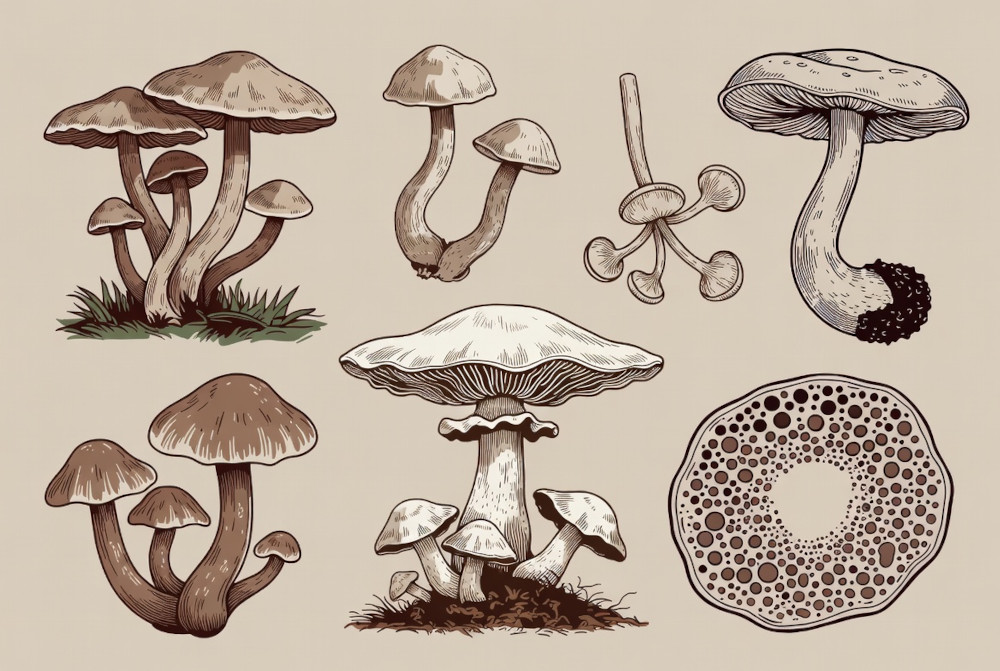

Mycology is a field of science that is gaining popularity. We’re learning more and more about mushrooms, so it’s no wonder that even the average person often wants to take a closer look at them. However, choosing the right material for research is crucial. Are you also interested in observing mushrooms under a microscope? Then here you’ll find a number of useful tips that will help you choose the right research material!
Why is it worth observing mushrooms under a microscope?
There are many reasons why microscopic examination of mushrooms, even for amateurs, is a fascinating activity. On the one hand, it allows us to better understand these organisms. Some of them can be distinguished solely by microscopic features, including the shape of the spores or the presence and form of structures that can vary in appearance but species-different organisms. Furthermore, it’s a great way to learn about the life cycle – from the formation of hyphae, through the development of fruiting bodies, to the development and release of spores.
If, however, microscopic observation is not just entertainment for you, but also a potential professional pursuit – observing these organisms helps enrich your personal skills and abilities. The microscopic features of fungi are highly diverse – precisely examining and documenting them develops comparative and analytical thinking. You can also expand your biological science methodology by using dyes to mark characteristics or taking measurements.
Ultimately – mushrooms on both the macro and micro scales are beautiful. On the one hand, hyphae can create perfect symmetry, but on the other, they often form geometrically complex structures characterized by enormous diversity. These organisms can be a form of artistic inspiration for many.
Choosing Mycological Material for Observation – Key Factors
As you can see, there are many reasons to observe fungi under a microscope. It’s time to learn how to properly select mycological material for observation. The most important criteria that can be listed include:
- researcher’s experience,
- observation purpose,
- quality of the obtained material.
Below you will find more detailed explanations of why these issues are the most important.
Observer Experience
Mushroom materials differ not only in terms of mushroom species or varieties. Individual organisms exhibit varying sensitivity to handling. Some, for example, are very resistant to all contamination, and it takes a real effort to contaminate the package containing the mycelium or fruiting bodies. Therefore, they can be more forgiving to beginner mycologists, who often make mistakes when collecting samples for observation. Others, however, are very sensitive to even the smallest contamination. In such a case, extreme caution is required, as many days of work could be wasted because, for example, mold might start to grow in the bag.
Experience is also useful when observing mushroom development. It’s important to remember that for some species, allowing fruiting to occur is highly undesirable. This is the case, for example, with the mycelium of Psilocybe cubensis. Although its mycelium and spores are free of substances prohibited in Poland, the fruiting bodies already contain psilocybin, which is legally prohibited. Therefore, you need to be able to determine when such a grow kit needs to be destroyed to prevent the fungus from developing further.
Think about what exactly you want to see
Mushrooms are not just stems and caps. They are a wide variety of structures to observe. Therefore, it’s worth considering the purpose of your study – do you want to better understand the earlier stages of fungal development? Or rather their mature life? Or understand the development cycle from beginning to end? This – contrary to appearances – has a significant impact on the choice of mycological material. As I mentioned above, for some species, you can only study the early stages of development of these organisms. However, I guarantee that each of them will provide you with an incredible experience observing them under a microscope.
Choose high-quality material from trusted suppliers
Ultimately, where you get your material for observation is crucial. If you don’t want to risk buying an unknown product, possibly of low quality, it’s best to choose a reputable supplier with an established market position. On the one hand, it’s about security. Mycological materials can usually be purchased for around 100-150 PLN or slightly more (depending on the rarity of the species or variety, among other things). It’s not a “crazy amount,” but it’s always better to protect yourself from making a bad purchase.
On the other hand, it’s important to remember that this is biological material. It can produce various compounds that could potentially pose a threat to the researcher. By choosing a product from a reliable source, you can be sure you’re choosing predictable preparations. Therefore, you know what to expect from them.
Observing fungi under a microscope is more than just fun and learning.
These three criteria should be enough to help you choose the right mycological material for your research. As you’ll discover, mushrooms are amazing and can tell us a lot not only about their lives, but also about ourselves. Thanks to them, many people often discover a passion and a desire for further exploration. Self-discovery is the best way to grow.