

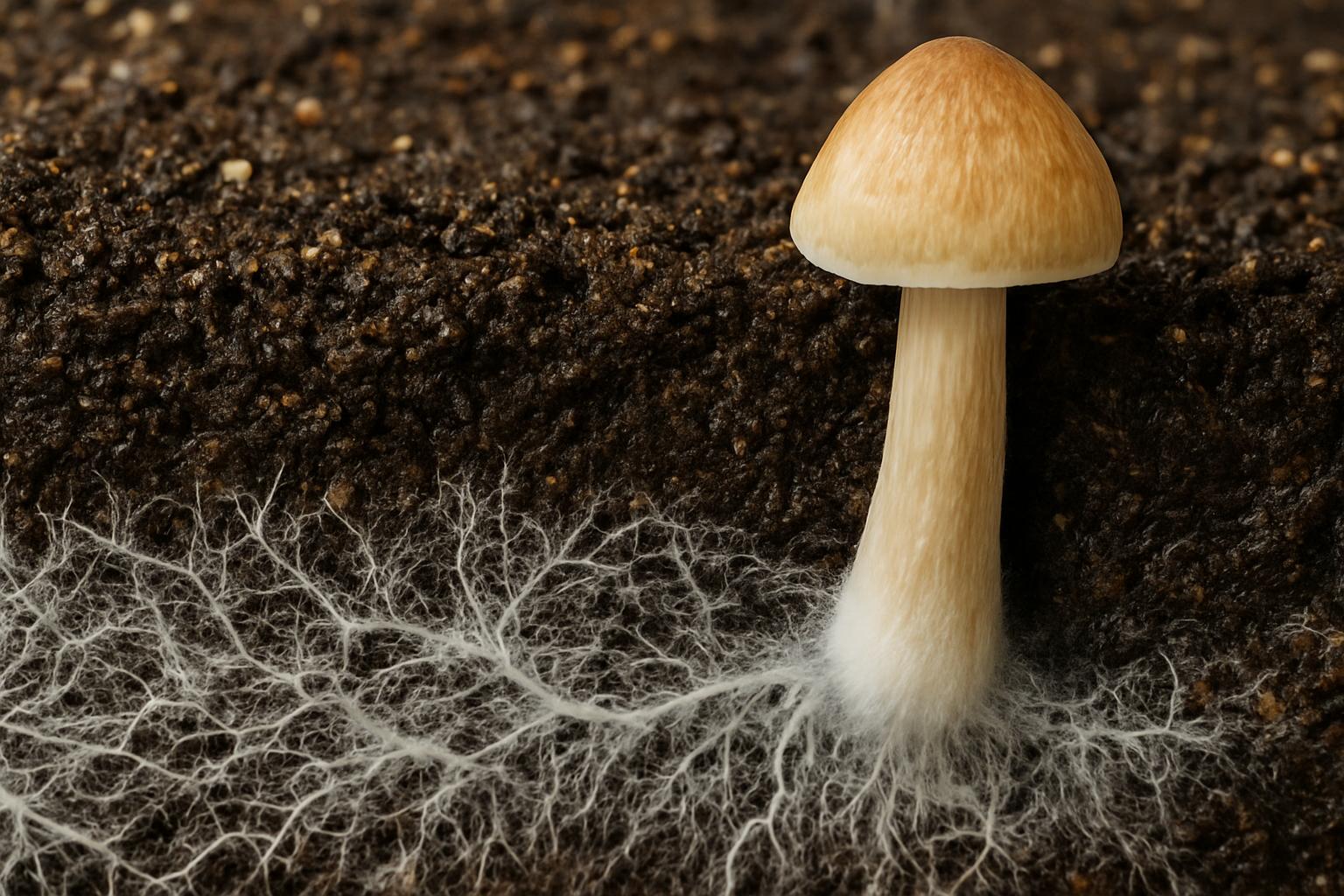

Often, when we say “mushrooms,” we’re referring to their fruiting bodies. However, the term “fungus” refers to a more complex organism than what we see. What’s also important is what’s usually invisible on the surface—the mycelium. What is it? What’s the relationship between it and the fruiting body? I answer these and other questions in this article. If you want to learn more about mycelium culture, but also about mushrooms themselves, I encourage you to read on!
What is mycelium? – what does it consist of and how does it work?
Mycelium, thallus, mycelium – various names are used. It usually grows deep within the substrate, sometimes on the surface. Depending on the species, its diameter reaches several to a dozen meters, although there are also organisms that cover several hectares (sic!). Mycelium sometimes forms rhizomorphs, root-like structures that entwine, for example, fallen trees. Simply put, it can be called the “body” of the fungus.
Hyphae are the basic building blocks of mycelium. They are a type of cell that tends to branch extensively and form networks. They burrow into soil and organic matter (including dead plants), decompose them, and extract the nutrients needed to perform specific functions. They vary in length, thickness, and structure.
Since I mentioned functions, mycelium is essential for fungi to survive in given conditions. Mycelium obtains nutrients from the environment by decomposing organic matter, releasing minerals and other elements that enter the soil, enriching it and transporting them between different parts of its network. These ingredients include:
- sugars,
- amino acids,
- phosphates,
- water.
What is a fruiting body – how does it form and why does mycelium produce it?
Every organism must reproduce to survive. Among fungi, this occurs both sexually and asexually. This is precisely why fruiting bodies are needed. They develop when the mycelium is ready to reproduce, due to factors such as the prevailing conditions, such as appropriate humidity, temperature, nutrient availability, mycelium maturity (including the accumulation of micronutrient reserves), and trigger mechanisms – favorable sunlight, cooling, or the occurrence of heavier precipitation.
Fruiting bodies are composed of compact mycelium fibers (they form the so-called pseudo-tissue). Their purpose is to produce spores, which enable the fungus to reproduce more effectively. They come in a variety of shapes. We associate them primarily with stems and caps, with spores produced in the hymenorphs (the underside of the “cap”).
It’s worth knowing that depending on the type of mushroom, the shape of the fruiting body can vary dramatically. In addition to the above-mentioned, we can also distinguish the following:
- spherical (typical, for example, for puffballs),
- cupped (common among sac fungi),
- consol-shaped (growing on the sides of tree trunks),
- coral-shaped,
- club-shaped,
- rod-shaped.
In short, fruiting bodies are sexual reproductive structures that produce spores (called meiospores). It’s worth noting that a single fruiting body can produce up to billions of spores, which are dispersed upon reaching maturity by releasing them. Because meiospores are very light, they are easily carried by the wind.
The Complex Life of Fungi
As can be gathered from the above information, the mycelium and the fruiting body of a fungus are two different forms of a single organism. The former is responsible for vegetative functions and survival, while the latter… well… is a form of reproductive organs (in a nutshell), ensuring effective reproduction. However, research conducted on mushrooms provides a wealth of intriguing information about them.
Until recently, it seemed that their primary function in nature was to decompose dead organic matter, from which they themselves obtain nutrients, but also provide them to plants through mycorrhiza (a type of symbiosis between fungi and, for example, trees). Hence, for example, you can often find boletes under birch trees, and boletes under oaks, beeches, and spruces.
However, research conducted since around 1990 has provided other, intriguing insights into the functions of fungi. Because they build extensive mycelial networks in the soil, they connect various organisms, resulting not only in an effective exchange of nutrients but also… information. The term Wood Wide Web, which can be translated as “forest internet,” is often used in this context. However, it’s more like a neural network through which plants and fungi can communicate—to the point that trees can recognize their seedlings. This network is conducted by electrical impulses with a potential of 1-4 Hz.
Mycelium – a structure we’re still learning about
Hyphae grow, branch at different rates, form aggregates (mycelium clumps), and undergo various morphological changes in response to nutrients. We are constantly learning about the complex nature of fungi. We know for sure that these organisms play a huge role in the life of the entire environment. The conductivity of nutrients, as well as electrical impulses, makes mycelium more often associated with the nervous structure of a living organism, which prompts us to change our thinking about this kingdom. Liquid mycelium culture allows for microscopic examination of what’s happening on a scale of several to a dozen or so hectares under controlled conditions. You can find such products for microscopic examination in Mykolaborian’s offer.