

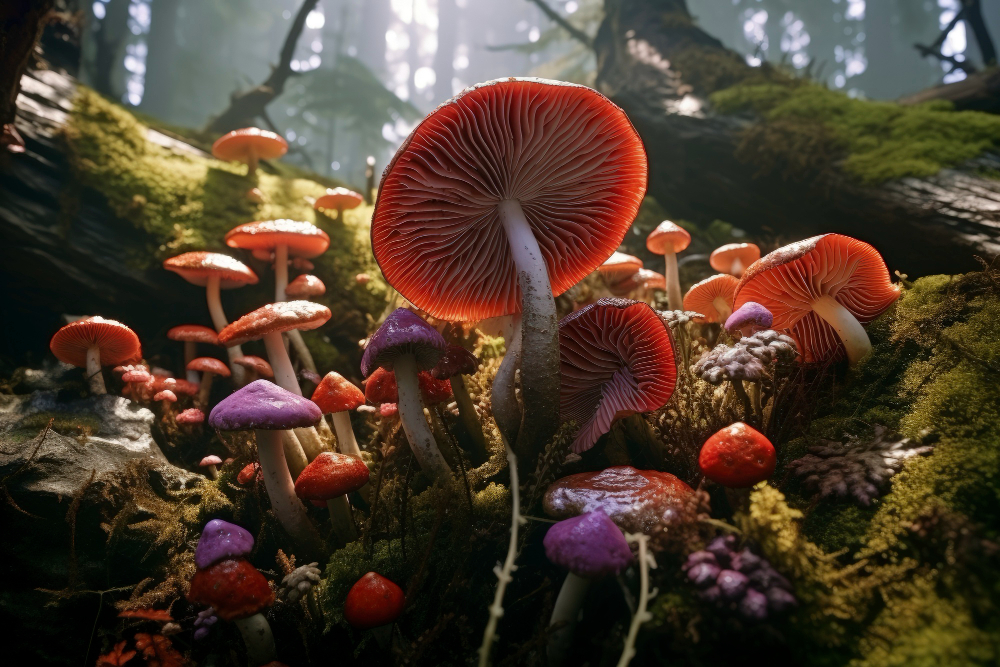

They go by various names – magic mushrooms, hallucinogenic mushrooms, truffles (although this term is more often applied to their specific form)… However, they all have one thing in common – they produce specific psychedelic effects. Different species, most of which belong to a single genus, can cause distortions of perception and even profound visions. Some even claim that taking them has completely changed their perception of the world and themselves, and consequently, their lives. What does this look like in reality? What are the facts about such experiences? Let’s check it out!
Hallucinogenic mushrooms – what species are we talking about?
Most specimens said to induce hallucinations are so-called psilocybin mushrooms. This can be understood in two contexts – organisms belonging to the broad genus Psilocybe. These include, among others, Species such as:
- Cuban Psilocybe (Psilocybe cubensis),
- Sword-shaped Psilocybe (Psilocybe semilanceata),
- Mexican Psilocybe (Psilocybe mexicana),
- Psilocybe azurescens (Psilocybe azurescens).
On the other hand, the term “psilocybin mushrooms” is also used more colloquially. In this case, we are talking about all organisms that produce psilocybin but are not classified as psilocybes. These include selected species from the genera:
- Copelandia, including Copelandia cyanescens,
- Panaeolus , including Panaeolus cyanescens .
It’s worth knowing that psilocybin is not the only substance produced by mushrooms that causes hallucinations. For example, a sufficient amount of fly agaric mushroom, which contains ibotenic acid and muscimol, can also cause perceptual changes. However, the mechanism of action of these compounds is different from that of psilocybin (more on this later in the article).
What are the effects of hallucinogenic mushrooms?
As I mentioned above, psilocybin is crucial for inducing psychedelic effects after consuming specific species of mushrooms. It is an alkaloid with a specific chemical structure that resembles serotonin. It is a so-called serotonin receptor agonist, especially 5-HT2A. Through these receptors, it affects two important brain centers – the default mode network (DMN) and the prefrontal cortex. Why is this important?
The DMN is responsible for introspective experiences and focusing on activities (including meditation and daydreaming). Psilocybin reduces its effects, leading to, for example, mystical experiences, including greater unity with the world, but also a kind of ego deconstruction. The prefrontal cortex, in turn, is the area of the brain responsible for:
- mood,
- consciousness,
- cognitive abilities.
In addition, psilocybin also affects the thalamus, which is responsible for processing stimuli (both tactile and (both taste and vision) and information integration, the hippocampus (responsible for emotions and memory), and the cerebellum (balance; motor coordination).
Psychedelic Effects of Psilocybin
As a natural serotonin receptor agonist, psilocybin (or rather psilocin, into which the alkaloid is converted) binds to 5-HT2A, present primarily in the cerebral cortex. This leads to a so-called cascade of changes in neuronal activity and increased excitability. Based on this, the brain becomes more sensitive to stimuli and begins to process them differently, amplifying or perceptually transforming them, inducing various hallucinations. If DMN activity is also reduced, entire “visions” can occur. It is at this stage that synesthesia, the perception of specific stimuli through various senses, occurs, on the one hand, and the mystical, transcendental experiences described by people with extensive experience with these compounds occur, on the other.
What do psychedelic experiences depend on?
The psychedelic experiences induced by hallucinogenic mushrooms are a fact, resulting from their chemical effects on the brain. However, the type of effect induced is largely individual and depends on a number of factors. The dose is an objective factor. The smallest amounts of psilocybin may, but do not necessarily, cause hallucinations. It’s often said that they sharpen the senses, improve creativity, and increase openness to experience. However, the higher the dose, the greater the likelihood of perceptual changes. It should also be noted that large doses of psilocybin can cause the so-called Bad trips, i.e., bad feelings and fears.
Other factors that influence the possible effects of taking hallucinogenic mushrooms include:
- Mood (the worse it is, the greater the likelihood of a bad trip),
- The environment present during ingestion (e.g., controlled, a group of trusted people, strangers),
- Weight body,
- metabolism,
- previously consumed food.
Psilocybin Mushrooms – Threat or Hope?
As I have already shown above, hallucinations or changes in perception caused by psilocybin mushrooms are a fact. However, the effects of psilocybin aren’t limited solely to inducing visions and hallucinations. A growing number of scientists, including those specializing in psychiatry, recognize the potential of this alkaloid in combating various ailments, including treatment-resistant depression, PTSD, bipolar disorder, and even addiction. However, research on this tryptamine is still ongoing, and the deeper we delve, the more interesting things we learn about it.