

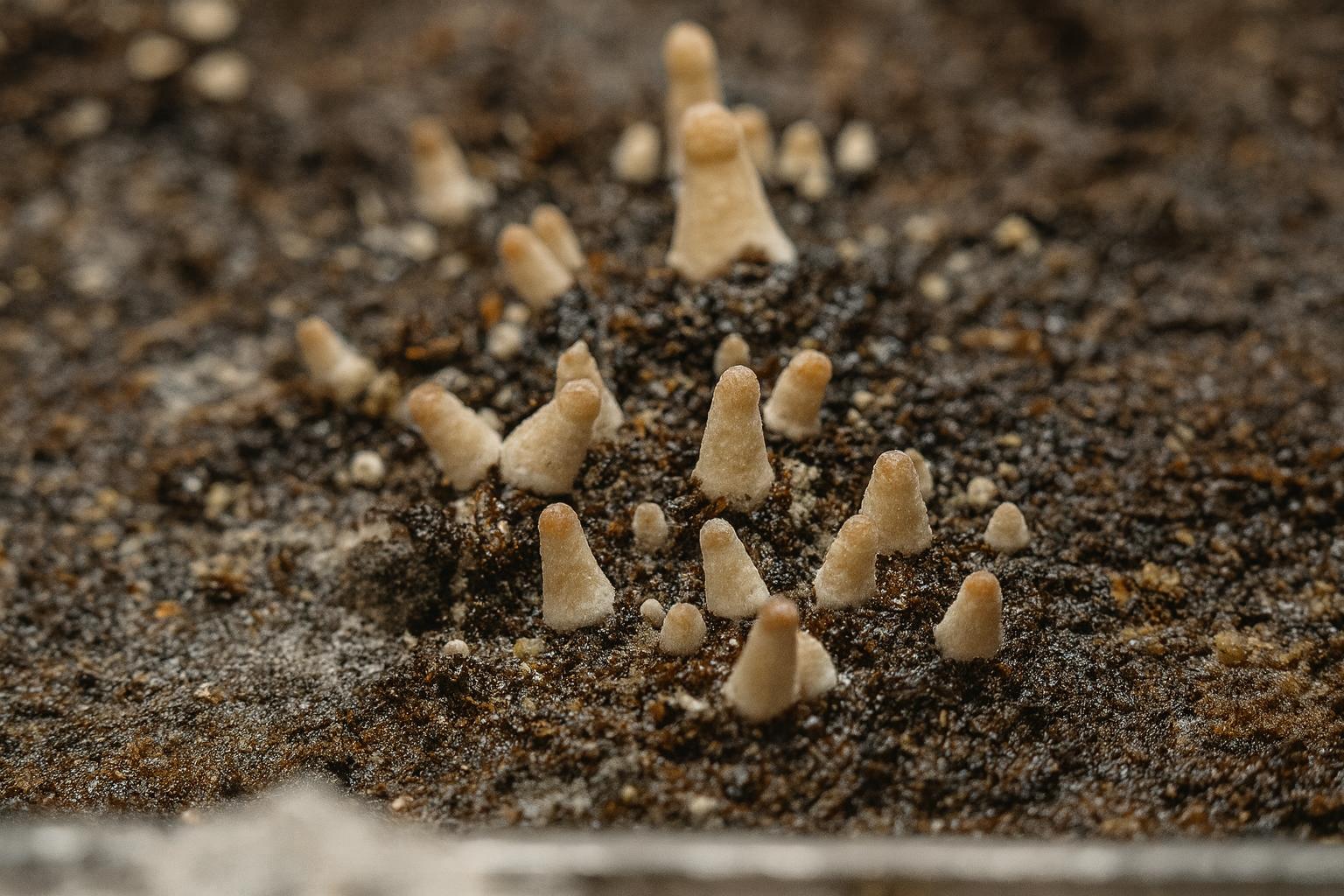

Anyone with even a casual interest in mycology knows how fascinating fungi are. Not only because of their functionality (especially species like Cordyceps chinensis and Lion’s Mane), but also their life cycle. One of its stages is the development of pins. What are they and what do they mean? When does the mycelium develop them, and what does it actually mean? I’ll answer these and many other questions below. So read this article to learn more about mushrooms!
Pin as an intermediate form between mycelium and adult fruiting body
Before talking more about when growkit will likely produce its first pins, it’s worth talking more about what the classic mushroom development cycle looks like. It’s important to fully understand why fruiting bodies actually form.
So, if we were to look at this “work of creation” from the beginning, the life of a fungus begins with a haploid spore, developed by fruiting bodies and carried by wind or animals. From this spore, filamentous hyphae begin to grow, which over time form the so-called primary mycelium. However, when it encounters a second mycelium with a different sexual type, they fuse (they then form a binucleate – dikaryotic – mycelium). In nature, this process can take years. During this time, the fungus slowly reaches maturity and continues to grow, colonizing the substrate (in a growkit, this will be the substrate).
At a certain point, the organism reaches maturity and accumulates the appropriate amount of nutrients, indicating its readiness to reproduce. Fungi, on the other hand, can reproduce in two ways – asexually and sexually. In the former, we are talking about fragmentation of the mycelium, budding, and the production of asexual spores in special sporangia. In the latter, we are talking about the production of fruiting bodies, which are a type of “sexual organ” for fungi that disperse sexual spores. These, in turn, grow from the pins that this article covers.
Pins and Primordia – What Are They and What Do They Look Like?
When discussing what mushroom pins are, what they look like, and when they appear, we can’t overlook an important element: primordia. This term refers to the fruiting bodies. They are clusters of mycelium cells that bloom on the surface of the fungus when it is ready to reproduce. To the untrained eye, they appear slightly different from the rest of the mycelium, but experts know that these small nodules and fibrous clusters will eventually develop into fruiting bodies.
The next stage is the development of pins. As the name suggests, these are pin-shaped structures. They grow from the primordia, taking on a slightly more “mushroom-like” shape, creating a form (and coloring) characteristic of the species. If we were to examine them under a magnifying glass, microscopic caps and stems are clearly visible. The development of primordia and pins indicates that the mycelium has entered the reproductive phase.
Under what conditions do pins form in growkits?
For the mycelium to transition from the vegetative stage (growing on a substrate or other medium) to the generative stage (producing fruiting bodies), it must, on the one hand, reach the appropriate maturity, and on the other, appropriate environmental changes are necessary. This works a bit like plants, which enter the vegetative stage in winter and then produce leaves, flowers, and fruit in spring and summer. So what stimuli cause mycelium to start producing pins?
- Lower temperature – fruiting usually occurs when thermal conditions slightly decrease (which is why, for example, the peak season in forests falls between late August and early November).
- Higher air humidity – fruiting requires sufficiently humid weather, sometimes even as high as 90-95%.
- Fresh air – this condition applies primarily to mycelium in grow kits. CO2 often accumulates in growth packs. When the concentration of clean air increases, the first primordia and pins may appear.
- Access to diffused sunlight – not direct exposure, but access to sunlight triggers reproductive processes in the mycelium.
In this context, it’s also relevant to ask when pins will appear in grow kits once they have favorable conditions. Assuming we’re dealing with fully mature mycelium, it may take 1-3 days from the moment the primordia appear before you see the “pins.”
How can mycelium mature in a full auto grow kit?
An advantage for home mycelium researchers is that the growth kits offered by Mykolaborian are “full auto.” Simply place them in the appropriate location for the mycelium to begin colonizing and growing vigorously. The grow kit instructions, available on the store’s website, explain this process in detail. In short, it’s enough to place the package in a location away from sources of contamination, relatively warm, and with dim light.
Growkits from Mykolaborian – only for mycelium research!
At the same time, I would like to remind you that the growkits available at Mykolaborian are for research purposes only. If you suspect the mycelium might have developed primordia and continued to grow, you should “destroy” it by pouring boiling water over it, which is also described in the growkit instructions. This is due to the fact that these are mushrooms whose fruiting bodies produce psilocybin – a substance illegal in Poland.