

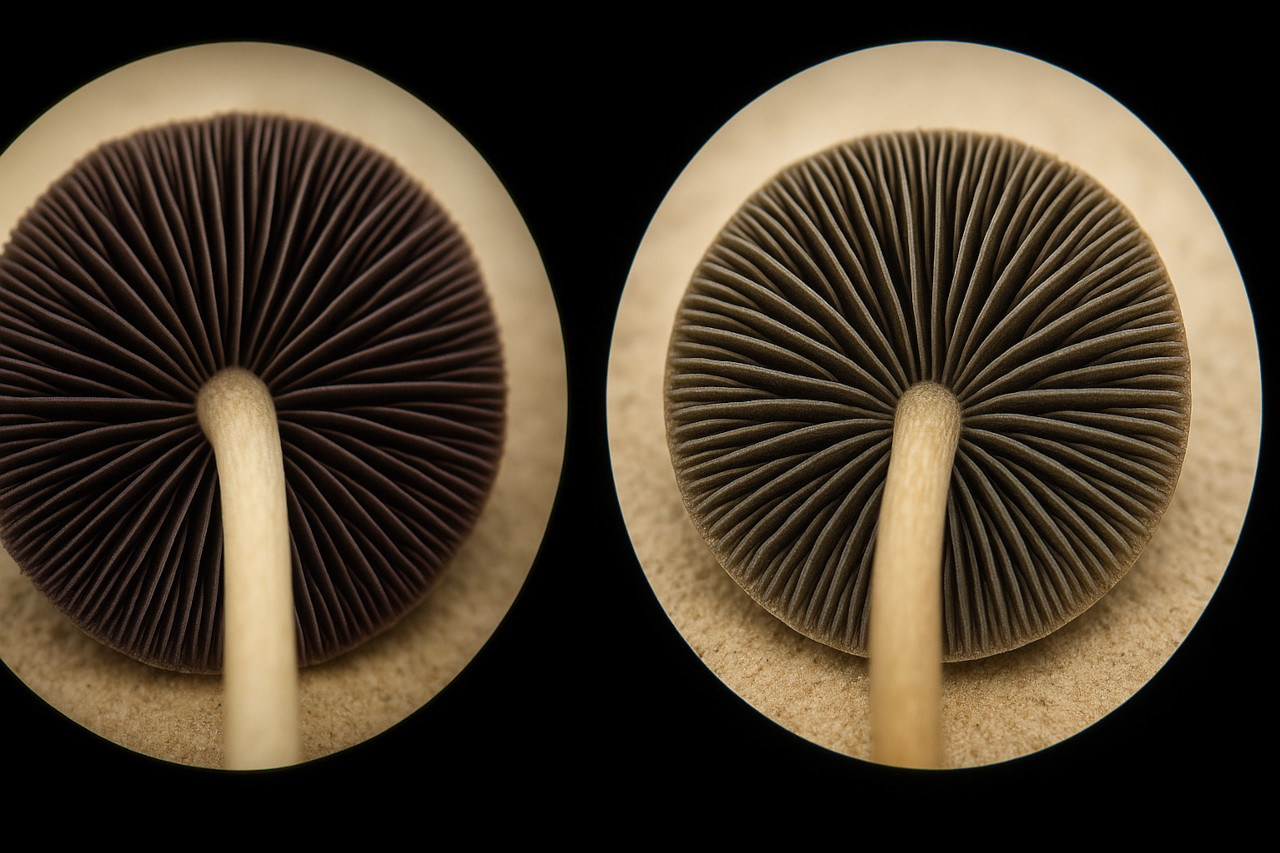

Although psychoactive mushrooms are usually associated with species of the genus Psilocybe, these properties may also apply to other organisms in this kingdom. Examples include those from the genus Panaeolus. How do Psilocybe vs. Panaeolus compare? What distinguishes them? And in what ways are they similar? I address this issue in this article. If you want to learn more about these intriguing organisms, read it now.
Psilocybin Mushrooms – Key Features
Psilocybin mushrooms are primarily those that produce psilocybin. However, it’s important to note that this alkaloid can also be produced by species outside this genus. Therefore, for simplicity’s sake, I will primarily describe those belonging to the Psilocybe genus.
On a macroscopic scale, they are usually mushrooms with conical or lanceolate caps with a characteristic umbo at the top. They have a smooth surface and can change color depending on humidity (usually in a range of browns, olives, yellows, and ochres). Their diameter ranges from 0.5 to 2 cm (usually). They grow on slender, long, and curved, thin stems—often hollow and brittle. They have dense gills that darken as they mature. The spores are dark brown, but can also vary in color. Fruiting bodies turn blue when damaged due to the presence of psilocybin.
Of the microscopic characteristics, the most important are the spore shapes. They are usually ellipsoidal, sometimes oval or slightly angular. They have a smooth surface and a large germ pore, and their dimensions vary depending on the species or variety. In the case of the Panaeolus lanceolata, they measure approximately 10.5-15 ✕ 6.5-8.5 μm.
Mushrooms of the genus Panaeolus – what distinguishes them?
This term covers the so-called Panaeolus mushrooms. Among them, there are many species with various importance in nature, but also… in the human diet. For example, the Panaeolus lanceolata is an edible mushroom, provided that young, completely white specimens are collected. Some Panaeolus species also produce psilocybin and psilocin, as well as other substances with psychoactive properties. More on this later in the article.
The caps are usually bell-shaped, hemispherical, or conical with a smooth, silky, or matte surface. They are hygrophanous, so their color can change depending on the environmental humidity. In this case, they become gray, brown, or olive. When dry, they are whitish, cream, or beige. The stems are usually straight and slender, sometimes widening at the base. They are usually hard and lighter than the caps. In some species, they turn a rust color. Lesions in certain varieties turn blue. Typical of these fungi are spotted gills – initially light in color, darkening with age (the spots then become more distinct). The discharge is black or blackish-brown.
The spores are very distinctive. They are shaped like lemons. They have a smooth surface and a large, eccentric germ pore. There is significant species variation in the size of the “seeds.” For example, in Panaeolus cyanescens they measure 12-16 ✕ 7-11 μm, and in the aforementioned Coprinellus cap-shaped mushroom they measure 10-15 ✕ 6-8 μm.
Main similarities and differences between Psilocybe and Panaeolus mushrooms
It’s time to make a clear comparison of their macro- and microscopic features. Let’s take a look at the species differences between psychoactive mushrooms.
Macroscopic Features
To the untrained eye, most mushrooms from both genera look similar. However, experts know how to distinguish Psilocybe from Panaeolus. The table below will make it easier for you to see the similarities and differences.
| Feature | Psilocybe | Panaeolus |
| Cap | Usually conical, bell-shaped, usually with a typical “umbo.” Hygrophanous, smooth surface, varying in color from light brown to dark shades of brown. | Often hemispherical or campanulate. It sometimes has an umbo, but this is not always the case. Like Psilocybe, it has a hygrophanous, smooth or silky surface. |
| Stipe | Slender, thin, and usually wavy. Hard or brittle, depending on the species. Bruises blue when damaged. | Slender and usually smooth. In some species, it may turn blue when damaged. |
| Glasses | Fused with the stipe, light in young fruiting bodies, darkening with age (from purplish-brown to black). | Spotted gills. They vary in color from gray to black or blackish-brown. |
| Spore Discharge | Purple-brown or dark brown. | Black or blackish-brown. |
Microscopic Features
Now that you know the similarities and differences on a macro scale between these mushroom genera, it’s time to compare them. spores of Psilocybe and Panaeolus .
| Psilocybe | Panaeolus | |
| Spores | Shape ranging from elliptical to oval. They are characterized by a large germ pore. | The lemon-shaped shape is specific to the genus, more angular in some species. Smooth surface with a large, eccentric germ pore. Size varies widely depending on the species. |
Similarities and Differences in Chemical Properties
Let’s also take a closer look at the chemical similarities and differences between the two mushroom genera. For a fair comparison, the next table will be useful.
| Chemical Property | Psilocybe | Panaeolus |
| Main Compounds | Primarily psilocybin and psilocin. Found in almost all Psilocybe species (with few exceptions). | Psilocybin and psilocin occur in select species (especially P. cyanescens). |
| Additional compounds | Baeocystin and norbaeocystin, usually in smaller amounts. | Rich in baeocystin and norbaeocystin. They also contain serotonin and bufotenine. |
| Alkaloid content | Varies, depending on species and strain. | Some species containing psilocybin and psilocin (including the aforementioned P. cynaescens) are richer in these alkaloids than some Psilocybe mushrooms. |
| Reaction to fruiting body damage | Many species bluish blue, which is characteristic of mushrooms containing psilocybin. | Only species containing psilocybin bluish psilocybin. |
What’s worth knowing about them? Tips for mycologists
Finally, a few tips for those who devote themselves to observing various mushrooms. When viewing them in the wild, it’s always worth observing the conditions in which they grow. This is also important for their identification, as they can differ in habitat. If examining the fruiting bodies doesn’t provide clarity about the species, microscopic features, including spore prints and their shapes, can be helpful. These are the basic features that facilitate differentiation.