

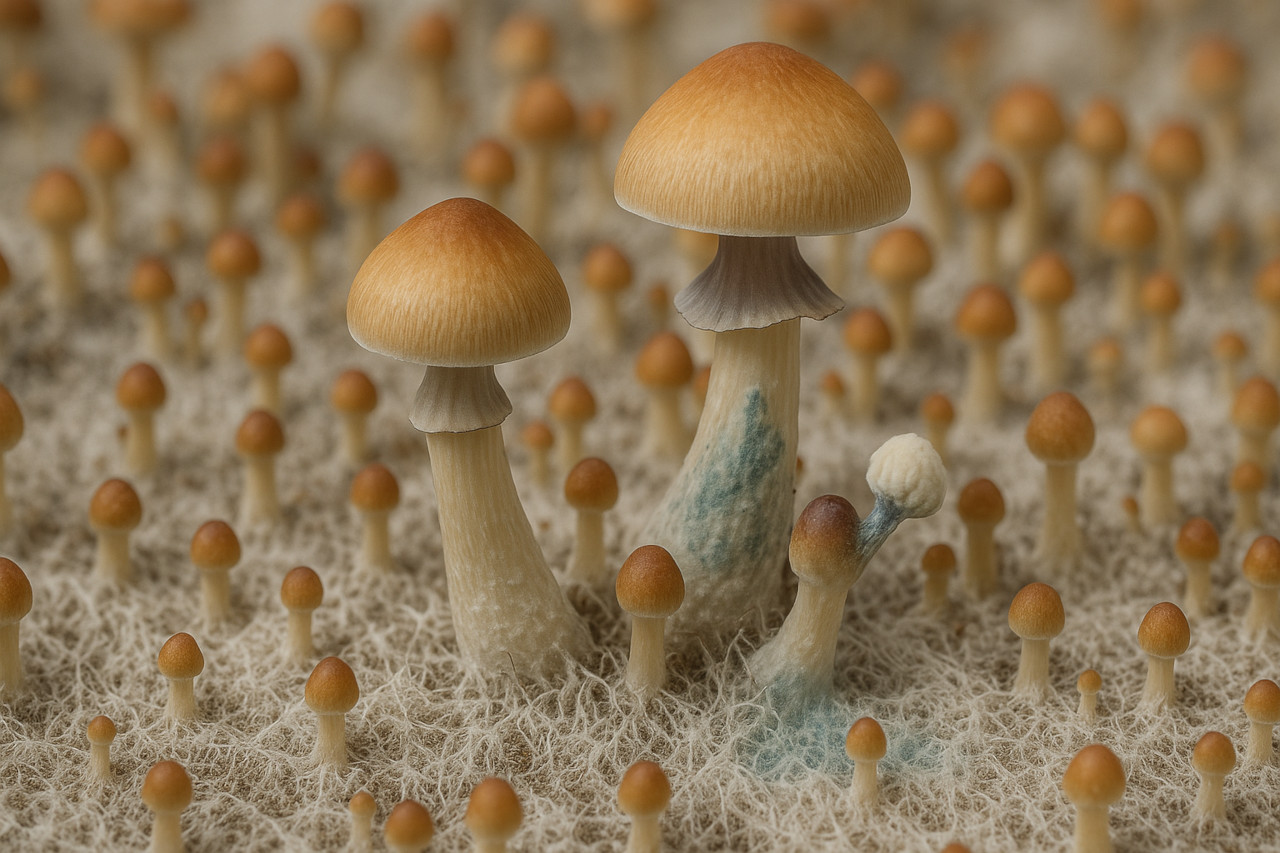

Mushrooms of the genus Psilocybe are absolutely intriguing organisms, with a wide variety of variations – not only between species but also within them. Of particular interest are the various phenotypes of Psilocybe cubensis, arising from natural mutations, as well as those developed by mycologists. It’s worth knowing that even in licensed cultivars, spontaneous mutations in the Psilocybe mycelium sometimes arise, sometimes leading to amazing discoveries. If you want to learn more about the mechanisms that ignite debates among mycologists – read this article!
The Most Important Information About Psilocybe Genetics
To fully understand how subsequent Psilocybe variants arise, you first need to understand the genetics of this genus a little better. In the case of Psilocybe cubensis alone, the existence of 46.6 Mb (megabases—that is, one million base pairs of DNA) was detected, among which a cluster of genes (a dozen or so genes close together) encoding enzymes responsible for synthesizing psilocybin and other alkaloids related to it was detected. Importantly, these clusters differ in other Psilocybe species, indicating a high degree of plasticity in their genetics.
In this context, methyltransferase is of particular importance. It is a key enzyme that, if the genes associated with it are mutated, leads to a modification of psilocybin production. On the one hand, it can limit or completely eliminate it, and on the other, it can significantly increase the production of this and similar alkaloids.
On the other hand, there are studies showing that current wild Cuban bald eagles, as well as those bred in laboratories, already have a domestication signature. This means that the gene pool is being limited, and obtaining new variants has become more difficult. Therefore, work on new strains can be tedious, but also incredibly satisfying. On the other hand, such a change in genes makes it easier to perpetuate the results of mycologists’ work by creating individual varieties.
One more thing to remember: nature abhors stagnation. For this reason, spontaneous mutations of hallucinogenic mushrooms occur. However, let’s discuss each of these issues in turn.
How do new mutations and variants arise?
DNA replicates during cell division or when forced by a laboratory technician. Each copy carries the risk of errors. A change in a single pair of nucleotides, the loss or insertion of a fragment, their duplication, or reorganization is enough to lead to the development of new characteristics. This is a brief description of mutations occurring in, among others, in fungi.
A number of factors, including those beyond the breeder’s control, are responsible for the induction of mutations. These include:
- extreme temperatures for a given organism,
- UV radiation,
- exposure to chemicals or biological contamination,
- nutrient deficiencies or excesses.
Furthermore, in cases of low genetic diversity, certain genes sometimes dominate entire lines.
During cell division, an inappropriate base or a gap in the genetic chain sometimes appears, causing the development of new, unexpected traits. However, if it turns out that it leads to the development of, for example, a new phenotype or specific properties of the fungus, it is preserved through appropriate procedures. Spontaneous mutations occur so often.
How are Psilocybes genetically stabilized in licensed growers?
It is crucial to discover the desired traits that the laboratory operator wants to preserve in the new strain. Then, a number of methods are used to stabilize them, including:
- selecting the best specimens with a specific phenotype,
- creating gene banks,
- backcrossing.
Through selection, for example, those fruiting bodies that display the most desired traits are selected (in the case of Albinos, for example, will be the lightest and most yielding.)
Genetic banks are collections of mycelium that preserve genetic diversity. They allow for the long-term storage of breeding lines for future use. At the same time, they protect breeders from losing important mutations in the event of experiment failure. They are especially used for difficult-to-obtain mutants.
Backcrossing, on the other hand, is a technique that helps preserve desired traits. It involves combining mutant specimens with the parent line, which introduces genetic stability. This method even isolates individual spores to obtain homogeneous cultures. So – in a nutshell – this is what genetic stabilization of Psilocybe looks like.
Example Psilocybe Phenotypes
Working on different strains is often a trial-and-error process. However, the results can be worth all the effort. Thanks to pioneers in this field, we have obtained various phenotypes of Psilocybe mushrooms, the most popular of which include:
- Penis Envy (PE),
- Enigma,
- Various types of albinos…
… and many others.
Penis Envy is probably one of the most famous Psilocybe cubensis strains, after Golden Teacher. It is characterized by a thick stem and a small cap. This strain also has delayed spore development and produces more alkaloids such as psilocybin and psilocin.
Enigma, on the other hand, doesn’t resemble a classic mushroom. On the contrary – it develops structures resembling a brain, walnuts… or a blob (depending on your associations). At the same time, it exhibits low stability, requiring constant work. This is probably where the name of this strain comes from – you never know what will ultimately grow.
Albinos, on the other hand, can be created by isolating fragments exhibiting albino characteristics from, for example, Golden Teacher. These fragments were then combined to create a fully stable strain. That’s how True Albino Teacher was born from GT.
What does Psilocybe genetics mean for amateur mycologists?
For amateurs who can only observe Psilocybe mycelium, rather than cultivate these mushrooms, the above information is also crucial. Mutations themselves often occur at the mycelium level. Sometimes, fragments are observed that differ from the rest, which may (but may not) be associated with a mutation that could be stabilized. Depending on the strain, observers may notice different behaviors in the “roots,” sometimes returning, nomen omen, to their roots, or developing entirely new structures. And the ever-emerging varieties only expand this diversity!