


Some, including Terrence McKenna and his followers, argue that without them, modern humanity would not exist. For others, they are a way to connect not only with the world but also with the spirits of the ancients, who performed similar rituals to those of our contemporaries. Hallucinogenic mushrooms, especially psilocybin mushrooms, have a long tradition of use in various rites and treatments. Today I will briefly describe the history of Psilocybe rituals. Discover it now!
The Oldest Evidence of Psilocybin Mushroom Use
There is diverse and abundant evidence of the use of hallucinogenic mushrooms in ancient times. This includes not only various paintings but also texts, including those considered sacred. It’s hardly surprising that treatises on them were included in them, since they can induce the most complex visions and cause “death” and ego reconstruction. The numerous traditions we have reach back to Africa, Asia, and (or even primarily) the American continents. Let’s take a closer look.
“Magic Mushrooms” in Ancient African Cultures
I’m starting with the “Dark Continent” because it is here that the oldest evidence exists that psilocybin mushrooms were used before the emergence of any civilizations. Cave paintings in caves located in southeastern Algeria, specifically at the Matalem-Amazar site located in the Tasil Van Ahjar massif, depicted, among other things, Human and humanoid figures with psilocybin mushrooms painted on them. These are believed to be Psilocybe mairei, which grow in Algeria and Morocco. The drawings are dated to around 7,000-9,000 BCE, although some accounts suggest they are as old as 10,000 years ago.
What exactly do the drawings depict? People dancing and offering mushrooms… but also a humanoid figure, most likely with the head of a bee, with mushrooms growing on its body. It is believed to be either a deity or a portrait of a shaman undergoing transformation.
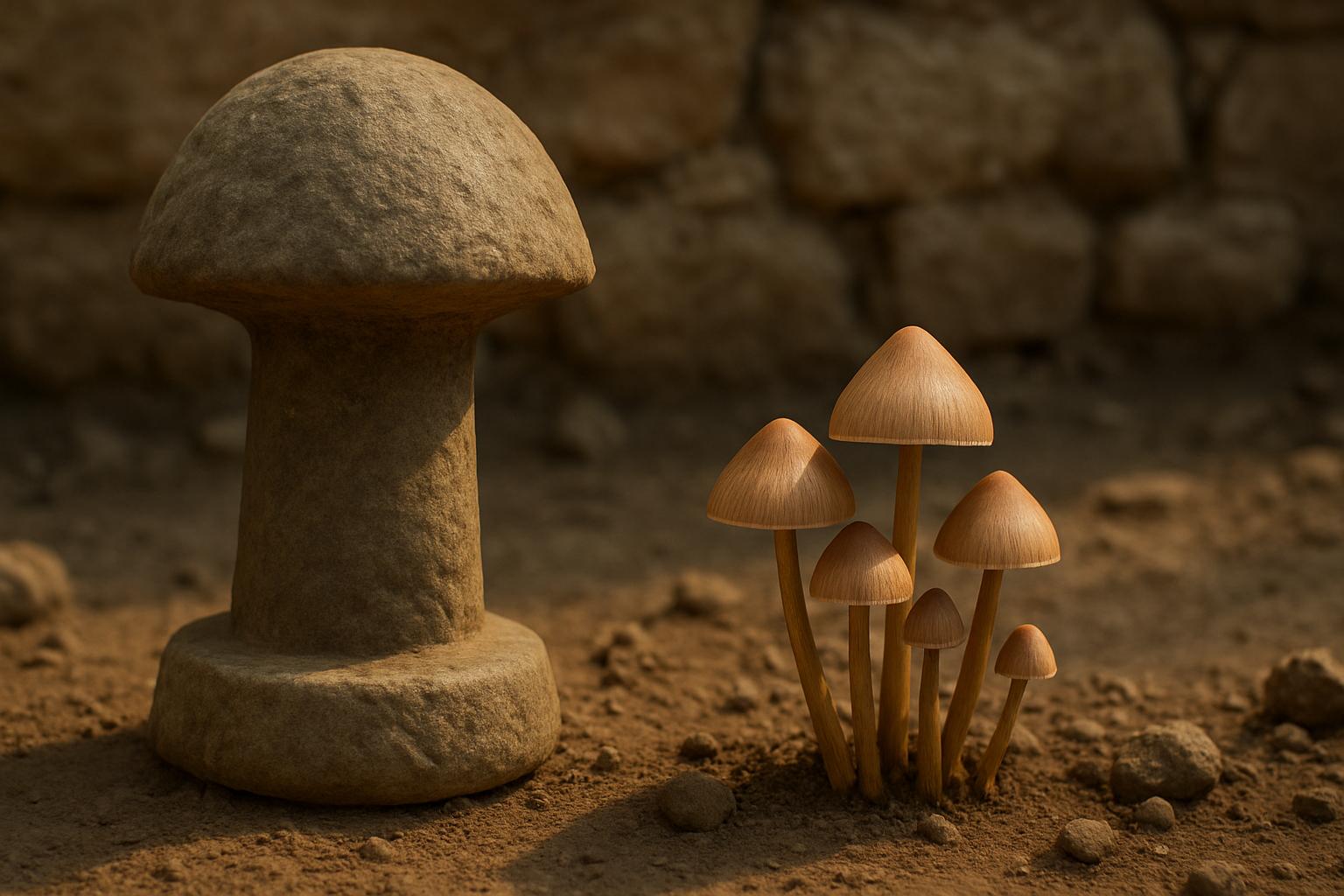
However, this is just one example from Africa. There were also sculptures, so-called Mushroom stones and “mushroom heads.” These are characteristic of the Sandawe and Bradshaw cultures of southeastern Africa, among others. The stones also bear patterns that—according to contemporary shamans themselves—represent visionary impressions induced by these mushrooms.
Psilocybin Mushrooms in Ancient Asia
Evidence of the use of hallucinogenic mushrooms in various rituals has also been found in Asia. One such example is a record contained in the Rig Veda, one of the sacred texts of Indo-Aryan cultures. Although the text speaks of “soma,” a divine drink that even grants immortality, many speculate that its ingredients were psilocybin mushrooms or fly agaric. Another theory suggests hemp, poppy, or the Cynanchum acidum plant.
Direct evidence of various ancient mushroom rituals is a woolen cloth discovered in a tomb in northern Mongolia. It depicts three warriors marching one behind the other toward an altar. The figure closest to him holds a mushroom, belonging not to the genus Psilocybe but to the Strophariaceae. Based on this, and the knowledge that the warrior belonged to a Zoroastrian people, it is believed that mushrooms were used to prepare Haoma. This sacred drink was not only consumed but also offered as an offering (this is how Jima, the first ruler of the Aryans, was supposedly born). Zoroaster’s father, Purushapsa, also made offerings. This demonstrates the important role of mushrooms in the religion of these cultures.
Psilocybein pre-Columbian cultures
Historical examples of the use of psilocybin mushrooms in various rituals can also be found in American cultures. It has been suggested that, alongside ayahuasca and peyote, they were a key ingredient in various rituals. For example, in countries located in the area of modern Mexico, the use of teonanácatl mushrooms, which we know as Psilocybe mexicana, was popular. Bernardino de Sahagún, a Spanish friar from the turn of the 15th and 16th centuries, who was on a mission to the Aztecs and other local tribes, wrote about them.
Figurines depicting mushroom people have also been found in areas inhabited by the Maya (including Guatemala). Interestingly, they were discovered near small millstones. This suggests that the fruiting bodies had to be harvested, dried, and then ground. This was likely how they were prepared for infusion. This and other evidence indicates the significant role mushrooms played in pre-Columbian cultures.
And what significance did psilocybin mushrooms have in ancient Europe?
Although there are few reports from the Old Continent, we know that mushrooms must have played a significant role there as well at various historical periods. For example, the Selva Pascula mural in Spain depicts a bull with mushrooms (believed to be Psilocybe hispanica) arranged in a row resting beneath it. This painting is estimated to date from around 4,000-6,000 BC. This most likely indicates a ritualistic nature.
The Rich History of Forbidden Mushrooms
Various types of psychoactive substances were used in virtually every corner of the Earth. Some peoples treated them as medicines for various ailments. Others treated them as a way to contact spirits or gods. We know for certain that they held immense significance for primitive cultures. Today, as research shows, their role may change, but it may be equally important from the perspective of individuals and entire communities.