

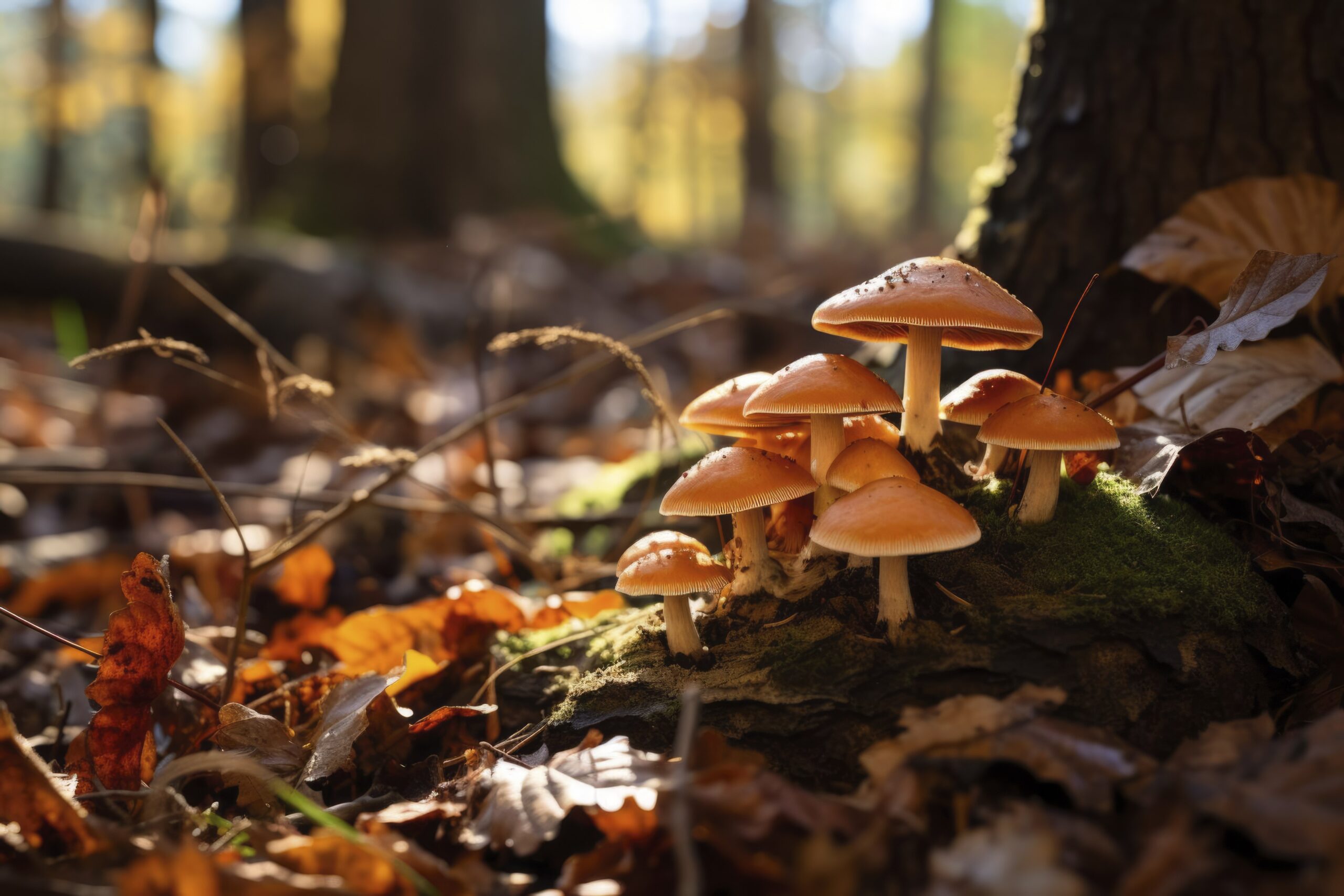

Poland is a country with an exceptionally rich mushroom-picking tradition. Some experts, however, venture into the forest to find and observe hallucinogenic mushrooms in the wild. Although these are primarily associated with warmer climates, species that produce psilocin and psilocybin also occur in our latitude, including the lanceolate and black-brown Psilocybe. I discuss them more in this article. I invite you to read on!
Psilocybin, or Hallucinogenic, Mushrooms – Their Importance in Nature and Beyond
Both species are saprotrophs, meaning they feed on organic waste, breaking it down into simple components that are returned to the soil. They are therefore an important element of the natural cycle of matter.
And what about human use? On the one hand, they are banned by law, which classifies them as narcotics. On the other, they are seen as a chance for people suffering from various mental health conditions. Some also use them recreationally. I’ll write more about this at the end.
Hallucinogenic Mushrooms Growing in Poland
Various types of hallucinogenic mushrooms grow in Poland. In this article, however, we will focus primarily on the aforementioned mushrooms, as well as another species that may be quite surprising to many. Get to know them now!
Psilocybe semilanceata
Psilocybe semilanceata, or Psilocybe semilanceata, is one of the most widely recognized psilocybin mushrooms found in Poland. It owes its hallucinogenic properties to psilocybin. It belongs to the family Psilocybe semilanceata. This is a well-known and long-described species that, in the early Middle Ages, could potentially have been used by shamans to contact the gods or by warriors (including Scandinavian berserkers) to whip themselves into a frenzy.
Despite its incredible properties, it’s a relatively inconspicuous mushroom. It grows on hollow stems up to 2 mm thick, usually 5 to 10 (some accounts say 12) centimeters long. The caps are typically conical with a distinct peak. They are quite narrow, measuring 1 to 2 cm. The Psilocybe lanceolata is blue when wet (indicating the presence of psilocybin).
The “caps” are olive to light brown, sometimes speckled with darker spots. Often, when wet, narrow, light brown gills can be seen through them. The stems are usually light yellowish.
The Psilocybe lanceolata
It’s time to tell you more about the second mushroom on this list. The black-brown Psilocybe mushroom, despite its name, does not belong to the Psilocybe species (although it contains psilocybin and psilocin), but to the Deconica genus. It comes from a completely different family – the Annulate Mushrooms. Its Latin name is Deconica montana. It should be noted that it was previously classified as a Psilocybe mushroom.
And how do you recognize hallucinogenic mushrooms belonging to this species? They differ significantly from the lanceolate Psilocybe mushroom in the appearance of their dark brown (mahogany) cap. The cap of the black-brown Psilocybe mushroom has a softer crown, although it is initially conical. Later, it flattens out more. Even the curled edges straighten out! When wet, it becomes sticky, and the gills show through. These, however, are dense, sometimes even extending onto the stem. Among them are so-called interlamellar lamellae. They are initially dark brown, later lightening slightly.
The lamellae are short and thin – up to 3 cm high and 2 mm thick. However, unlike the lanceolate lamellae – they are straight, sometimes wavy. Initially, they are solid, but with age, they become hollow. The legs are brown and are usually covered with fibrous remnants of the protective covering.
Natural occurrence of the Sword-tailed and Black-Brown Psylliums in Poland
The Sword-tailed Psylliums prefer warmer and moister habitats, such as forest edges and thickets, pastures, the edges of cultivated fields, and meadows. They can be found in tall grasses, among other places. They feed on animal droppings and decaying plant debris. They are most common in upland and mountainous areas (e.g., in mountain pastures where sheep graze), although there are also reports of them being recorded in other regions of the country.
The black-browed Psittacus is most common in the north of the country. Like the lance-toed Psittacus, it prefers pastures and meadows, but it also grows in areas such as forests. in peat bogs, deep in forests, and on heathlands.
Are there other hallucinogenic mushrooms in Poland?
For the record, it’s worth mentioning that, in addition to these, fly agaric is also mentioned in the context of magic mushrooms. However, this is not due to the presence of psilocybin, but rather bufotenin, which has similar properties. For this reason, more experienced mushroom pickers collect them during autumn mushroom picking and prepare them accordingly.
Properties and effects of consuming hallucinogenic mushrooms found in Poland
Now that you know how to recognize hallucinogenic mushrooms found in Poland, you should learn a little about their properties. Both species have great potential for pharmacology. There are many studies demonstrating the potential use of psilocybin in the treatment of, among others:
- depression (including treatment-resistant depression),
- post-traumatic stress disorder,
- alcoholism and drug addiction,
- other types of addictions,
- trauma.
Despite being considered a drug with a high potential for addiction, there is no solid research indicating an actual correlation between consuming them and developing an addiction. However, only appropriate, professional laboratories with appropriate licenses are authorized to obtain such mushrooms.
It is worth adding that some people illegally obtain hallucinogenic mushrooms for recreational purposes. They can, on the one hand, induce a state of relaxation and stimulate creativity, and on the other, cause a whole spectrum of cognitive symptoms. It’s important to remember that taking preparations obtained from these species may result in a so-called bad trip, or an adverse reaction to psilocybin and psilocin.
Should you collect hallucinogenic mushrooms?
It’s important to remember that possession of such preparations is illegal in Poland. Therefore, you should not collect specimens from these species, and especially not consume them. However, it’s worth knowing that the prohibited alkaloids are produced exclusively by the fruiting bodies. So, if you want to observe the mycelium of hallucinogenic mushrooms, you can invest in growkit or liquid cultures. You can find them in Mykolaborian’s offer.
Also check out: Psilocybin Mushrooms – Types