

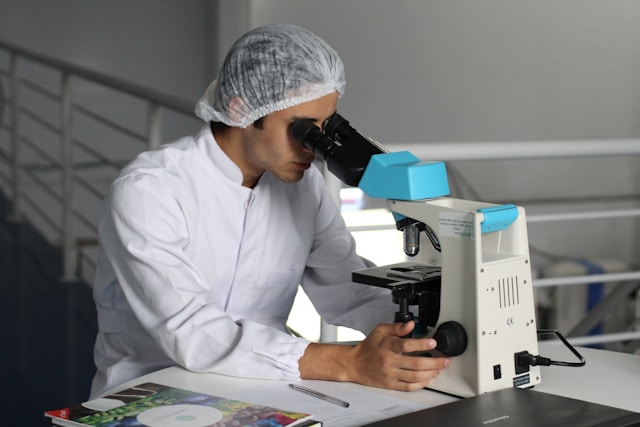

Mycology is a passion that’s enjoying increasing interest among a growing number of people. This stems from the fact that fungi, although theoretically well-known to science, still hold many secrets. Recently, the world of biologists, including mycologists, has been surprised by various reports about these organisms. It’s been suggested that, among other things, mycelium may be a kind of “nervous system” of the forest, through which trees and other plants communicate, and mature specimens recognize seedlings originating from their fruits… Intriguing and fascinating, isn’t it? For this and many other reasons, many people decide to conduct their own research on fungi. Here, I’ll tell you more about what it’s like to observe their spores. Please read on!
Not all fungi are the same – or parasitic fungi, saprophytes, symbionts, and more
Working with spores is demanding for several reasons. First and foremost, different fungal species behave differently. This means that examining mycelium under a microscope requires determining what type of organism we’re dealing with. Imagine that fungi can be, among other things:
- parasites (for example – rose rust),
- saprotrophs (meaning they break down inanimate matter, including dead trees or other organisms – e.g., molds or psilocybe cubensis),
- symbionts (living with plants in mycorrhiza, or symbiosis),
and also… predators (e.g., selected species of Cordyceps attack insects and induce them to behave in certain ways).
Okay, but the topic is observing fungal spores. So why would you be interested in their position in the “food chain”? For a simple reason – it determines, among other things, what kind of substrate you’ll need to prepare a colonizing preparation, which you can then observe on a microscope slide. For example, saprotrophs prefer organic, but dead, matter. They can therefore decompose animal feces, tree bark, and even properly treated grains. They are then divided into, among other things, for coprophagous insects, scavengers, necrophagous insects, etc.
Where to get spores?
There are basically two main ways to obtain material for mycological research. So-called spore prints are popular but difficult to perform. Furthermore, in certain circumstances, they can be illegal. The second – more proven, more reliable, and fully legal – is to obtain spores, or rather liquid cultures obtained from them, from suppliers. I’ll describe both methods in more detail below.
Preparing a spore print yourself
Obtaining spores by spore print is simply working with the fruiting body itself. This requires a mature mushroom that has not yet shed its spores. How do you do this?
You’ll need a sterile surface where the spores can fall. This can be food-grade aluminum foil. Place the cap on it, which should then be covered, for example, with a sterilized glass container. However, it shouldn’t be completely airtight. After about 12 hours, the print should be ready.
What’s the difficulty? On the one hand, spores often become contaminated this way. The air is filled with spores from other fungi, including molds, which can attack and contaminate the material. On the other hand, you can try to take prints of species legal in Poland this way. In the case of those whose possession and trade are prohibited, you won’t be able to do so, even though examining mycelium under a microscope, for example, that produced by the psilocybe species, is perfectly legal. This brings us to the second method mentioned.
Purchasing Liquid Cultures
Although these aren’t spores per se, they are material obtained from them, and some people use this term interchangeably as liquid cultures. Stores offer, among other things, mycelium in liquid form for wild mushrooms, but connoisseurs of exotic species will also find something for themselves. What’s more, for example, you can order liquid cultures of unique varieties of the Cuban Psilocybe on this website. Although the possession of this species of mushroom is prohibited, viewing the spores shed by these mushrooms under a microscope or the mycelium that has already grown from them, as well as trading them, is completely permitted.
This is a much less time-consuming and more reliable method, as liquid mycelium is free of contaminants and ready for application. However, you’ll need to demonstrate some skill when it comes to creating a grow kit for research.
How to inoculate mycelium in liquid?
Let’s assume you chose the second option. How do you go about inoculating a liquid culture? The product arrives in a syringe with a suitable cap and a sterile injection needle. To continue, you’ll need a substrate.
Appropriate substrate and container needed
For research purposes, you should create your own growkit. You can make one from a sterile bag or other plastic container that has been disinfected and has small ventilation holes. The preparation of the substrate depends on, among other things, the type of mushroom you’ll be working with. For forest mushrooms, for example, garden soil with peat and coniferous sawdust are used. To colonize mycelium from the “Cuban” family, you can choose one of the ready-made substrates or mix your own—for example, ground brown rice with water and perlite or another moisture-retaining material.
“Clean” spores—contamination is your enemy
Disinfecting or sterilizing equipment—from the container to all tools (including gloves)—is essential if you want to have material for research. Any contamination will most likely result in contamination and loss of your work. In other words, you won’t be able to enjoy the joy of observing mushroom spores.
The Right Conditions
For mycelium to begin growing, it needs the right conditions. The substrate alone isn’t enough. Specific mushroom species require specific humidity and temperature to thrive, usually around 20-25° Celsius. Additionally, they need to be protected from sunlight. Eventually, a “hair-like,” plastic structure, sometimes affectionately called “cake,” will begin to form. This is your mycelium for research!
What can and can’t you do with spores and mycelium?
Finally – a few words of explanation. Spores, as well as mycelium of various mushrooms, even those that produce psilocybin, are completely legal in Poland, as long as you use them for microscopic examination and observing how the “roots” grow. I provide the material for that purpose. However, you absolutely must not possess the fruiting bodies of such species. The law simply doesn’t allow it. However, the sheer pleasure of observing the mycelium colonization provides a lot of fun, and I guarantee you will be very pleased with your own mycological research. If you have any questions or concerns, please feel free to contact me.